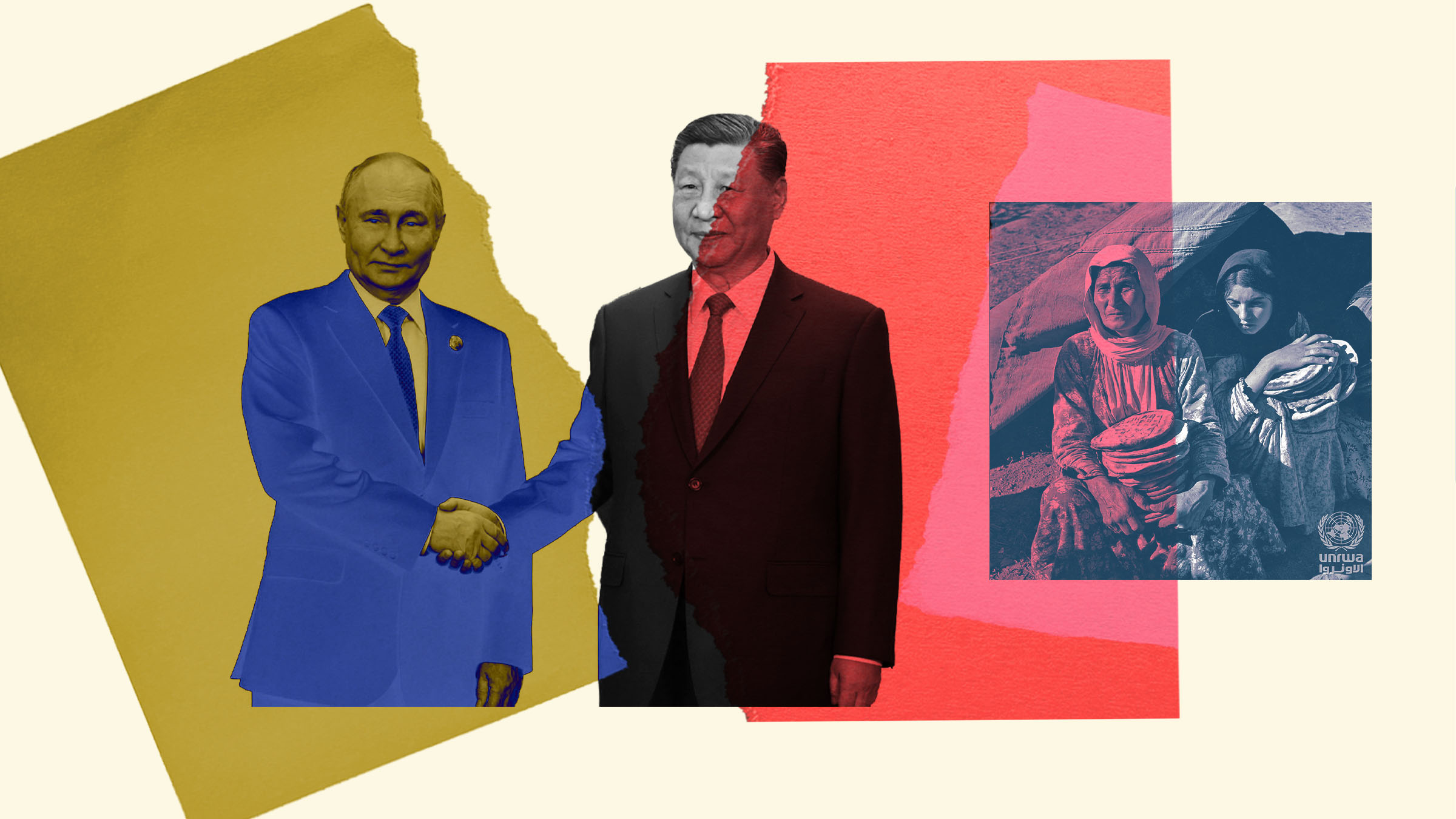
Great-power interaction intersecting with humanitarian conditions in a constrained operational environment
The Gaza Deadlock Under Great Power Competition:
A Forensic Analysis of Structural Vulnerabilities and Systemic Beneficiaries
Stratum IV – Tier 3: Definitive Structural Diagnosis within the Western-Built Composite and the geopolitical exploitation by RUS/CHN
Stratum 1 examined UNRWA’s structural complementarity with the coercive governance field in Gaza. Stratum 2 documented the collapse of neutrality verification in the Colonna Review. Stratum 3 analysed the institutional non-exit geometry producing the Gaza deadlock condition.
UNRWA – Structural Determination(Strata Series)
Each Stratum isolates one structural mechanism shaping the Gaza governance environment.
All analyses follow the same forensic template: Executive Frame → Forensic Core → Exhibits → Decision Architecture → Final Diagnosis.
Stratum 1 examined UNRWA’s structural complementarity with the coercive governance field in Gaza. Stratum 2 documented the collapse of neutrality verification in the Colonna Review. Stratum 3 analysed the institutional non-exit geometry producing the Gaza deadlock condition.
Section 1 — Executive Frame
UNRWA – Structural Determination Series
This analysis is Tier 3, Stratum 4 of a multi-part forensic series examining UNRWA’s structural role, the collapse of neutrality verification, the UN–UNRWA-Donor system relationship (Tier 2), and the geopolitical exploitation by RUS/CHN (Tier 3).
This Stratum 4 analysis examines how a Western-built institutional deadlock in Gaza—a dual governance composite consisting of UNRWA’s formative monopoly and Hamas’ coercive control—has become a platform for systematic exploitation by Russia and China. The analysis reconstructs a three-phase trajectory: (1) pre–7 October 2023 structural shaping, in which Moscow and Beijing preserved and monetised the deadlock without ownership; (2) post–7 October 2023 intensification, in which they converted the Gaza war into a high-yield field of delegitimisation and Western fragmentation; and (3) post-UNSC Resolution 2803 structural risk transfer, in which the United States, the UN system, Israel and donors assume responsibility for a single-band dismantling operation that is structurally unlikely to succeed, while Russia and China position themselves as external beneficiaries of any breakdown.[1]
The foundational structure is defined in three internal SSOT strata. Stratum 1 establishes the formative–coercive complementarity: UNRWA’s social-institutional infrastructure and Hamas’ coercive apparatus stabilize each other and resist partial interventions.[2] Stratum 2, grounded in the Colonna Review, demonstrates the procedural collapse of neutrality in UNRWA’s operations, converting neutrality from a presumption into a contested empirical variable.[3] Stratum 3 identifies the resulting deadlock condition: any single-layer intervention (acting on UNRWA or Hamas alone) generates systemic instability, incentivising strategic maintenance rather than structural reform.[4] This produces a hostage configuration: Western actors carry the political, humanitarian and reputational cost of the structure; non-Western competitors do not.
Phase 1 (pre–7 October 2023) is characterised by opportunistic exploitation. Russia and China consistently defend UNRWA’s institutional indispensability, oppose reform proposals, and frame donor crises, Israeli–UN confrontations and neutrality controversies as proof of Western inconsistency. This preserves a Western-built deadlock while delivering continuous delegitimising returns to Moscow and Beijing at negligible cost.[5][6][7][8]
Phase 2 (post–7 October 2023) does not alter the structure; it activates it. The Gaza war forces Western actors into unresolved contradictions between humanitarian protection, counter-terrorism, alliance commitments and domestic polarisation. Russia and China amplify accusations of Western double standards—contrasting Western responses to Ukraine and Gaza—thereby converting the deadlock into a high-intensity erosion mechanism. They assume no operational responsibility and experience no downside risk.[5][6][9][10][11]
Phase 3 (post-UNSC Resolution 2803, November 2025) represents a structural shift. The resolution authorises a US-designed peace plan, an International Stabilization Force and a new executive governance body, while leaving UNRWA’s formative layer untouched.[1][12][13][14][15] Russia and China abandon their earlier counter-draft, articulate strong reservations, then abstain rather than veto.[12][13][14][7][8] This is the precise configuration that maximises their strategic payoff:
- the United States, UN, Israel and donors acquire ownership of a structurally incomplete intervention;
- the probability of failure is high, because neither demilitarisation nor governance transformation is viable without simultaneous change to the formative layer;
- Russia and China incur no responsibility, retain narrative freedom, and can frame any disruption as Western hypocrisy, external domination or institutional incompetence.
Stratum 4 therefore does not attribute intent, planning or operational command to Russia or China. It treats the deadlock as a Western-made structure that they exploit through a consistent pattern of choices across the three phases. The analysis assesses how this pattern transforms 2803 into a high-risk Western ownership structure whose potential failure becomes a strategic gain for Moscow and Beijing.
- The full forensic analysis continues below, including Exhibits and Decision Architecture.
Section 2 — Evidence Base and Method
The evidentiary corpus integrates internal SSOT strata, UN documentation, state records, intelligence-linked reporting, and verified open-source material. Each factual claim is linked to a primary or high-authority secondary source. No inference relies on intent attribution.
2.1 Internal SSOT Strata
Stratum 1 – Structural Complementarity defines the formative–coercive duality of Gaza’s governance and explains its resilience against partial intervention.[2] Stratum 2 – Colonna Review provides procedure-level evidence that neutrality in UNRWA’s operations has collapsed as a verifiable category.[3] Stratum 3 – Deadlock Condition identifies the hostage structure created by the composite, detailing donor–UN–P5 constraints that prohibit single-band reform.[4]
These strata define the architecture into which external actor behaviour is mapped in Stratum 4.
2.2 United Nations Documentation
and Resolution 2803
Primary sources include:
- UNSC Resolution 2803 (2025) — the authoritative specification of demilitarisation, external governance, and the International Stabilization Force.[1]
- UN Press Release SC/16225, documenting the vote (13–0–2 with Russia and China abstaining) and the positions of Council members.[12]
- Security Council Report analysis of pre-vote negotiations, including the withdrawal of the Russian draft and objections to US opacity.[13]
- Chatham House external analysis of resolution design and sovereignty implications.[14]
- OHCHR statements on the resolution’s compatibility with Palestinian self-determination.[15]
- Together, these sources confirm that 2803 is a US-driven, high-ownership governance framework with unclear operational pathways and contested legitimacy.
2.3 Iran’s Support to Hamas, PIJ and Hezbollah
Iran’s financing, training and arming of Hamas, PIJ and Hezbollah is documented in:
- U.S. Treasury/UK Treasury coordinated designations exposing Iran-backed financial networks for Hamas and PIJ.[16]
- UK Parliament statements affirming Iran’s long-term financing of Hamas, PIJ and Hezbollah.[17]
- ECFR analysis situating Hamas/PIJ sponsorship within Iran’s broader strategic doctrine.[18]
- IranWire reporting on IRGC-QF transfers exceeding $1 billion to Hezbollah in ten months.[19]
Operational support and weapons flows are established through:
- Washington Post investigation citing intelligence sources on Iranian weapons, training and logistics provided to Hamas before 7 October.[20]
- FDD/Wall Street Journal reporting that hundreds of Hamas fighters trained in Iran during 2022–2023.[21]
- Council on Foreign Relations analysis detailing IRGC/QF support doctrine for Hamas, PIJ and Hezbollah.[22]
- Wilson Center analysis of Iran’s Islamist proxy network.[23]
- Encyclopaedia Britannica’s overview of the “Axis of Resistance”.[24]
This evidentiary block does not establish Iranian or Russian command over Hamas operations; it establishes structural sponsorship and capability transfer.
2.4 Iran–Russia Military Integration in the Ukraine War
Russia’s wartime dependence on Iran is supported by:
- Reuters and Guardian documentation of Shahed-131/136 drone deliveries beginning in 2022.[25][26]
- Institute for the Study of War, Institute for Science and International Security, and Adapt Institute analyses of Shahed-derived drone production at Alabuga SEZ under Iranian technical supervision.[27][28][29]
- Reuters reporting that Russia launched more than 8,000 Iran-developed drones during the conflict.[30]
This demonstrates a structural military reliance on Iran which forms part of the Russia–Iran–Hamas triangulation relevant to Gaza.
2.5 Russia–Hamas–Iran Contact Cluster (2021–2023)
A documented sequence of high-level contacts shows increasing depth and frequency:
- Senior Hamas delegations met Russian officials in December 2021, May 2022, and September 2022, including with Foreign Minister Sergey Lavrov.[31][32][33]
- In March 2023, Hamas representatives informed Russian officials that their “patience was running out”.[34]
- On 26–27 October 2023, Hamas leaders and Iranian Deputy Foreign Minister Ali Bagheri Kani held parallel meetings with Russian diplomats in Moscow—the first major Hamas diplomatic activity after 7 October.[35][36][37][38]
- This pattern shows sustained political resonance, not operational coordination.
2.6 Method
The methodological frame adheres to four constraints:
- No intent attribution. The analysis interprets effects, not motives.
- Mechanism-first reasoning. Each inference follows from an observable structural condition.
- Rival-model testing. Null, US-only, local-only and conspiracy models are evaluated and rejected where they fail to account for observed regularities.
- Source discipline. Only primary and high-authority secondary sources are used.
Stratum 4 is thus a forensic system diagnosis, not a narrative of culpability.
Section 3 — Structural Mechanism:
Dual Complementarity and the Deadlock
3.1 Formative–Coercive Duality
Gaza’s governance structure consists of two operationally inseparable bands:
- Formative band: UNRWA provides welfare, education, administrative continuity and social infrastructure. Its scale and mandate produce a de facto formative monopoly.[2]
- Coercive band: Hamas and aligned groups provide security enforcement, taxation, intelligence and territorial control.
The bands are mutually stabilising: the formative layer legitimises and sustains population management; the coercive layer guarantees operational continuity.[4]
3.2 Partial-Intervention Instability
Interventions targeting only one band generate:
- service collapse or security vacuum,
- compensatory overreach by the remaining band,
- subsequent reconstitution of a coercive–formative composite.
Stratum 3 defines this as a deadlock condition: a structural impossibility of modifying one layer without destabilising the system.[4]
3.3 Deadlock as Western-Built Hostage Architecture
- The composite is produced by:
- UNRWA’s entrenched mandate,
- Israeli security constraints,
- Palestinian political fragmentation,
- donor-driven institutional inertia.
This creates a hostage stack: Western actors bear the humanitarian, political and reputational cost of the system; external competitors do not.[4]
3.4 Predictable Vulnerability Output
The deadlock produces:
- contradictory Western imperatives (humanitarianism vs. security),
- institutional collisions (UNRWA neutrality crises, donor friction),
- narrative incoherence exploitable by external actors.
3.5 Integration into Phase Logic
- Phase 1: Russia/China preserve the deadlock to maximise erosion.
- Phase 2: The deadlock activates under wartime pressure.
- Phase 3: 2803 shifts ownership to the West while preserving instability.[1][12][13][14][15]
The deadlock is therefore the mechanical core of the strategic environment described in Stratum 4.
Section 4 — Phase Logic: Systemic Behaviour Across Three Phases
This section formalises how Russia and China position themselves across the three phases of the Gaza trajectory—pre–7 October shaping, post–7 October exploitation, and post-2803 risk transfer. The analysis does not infer motives; it reconstructs a consistent pattern of structurally rational choices within a Western-built deadlock. The defining feature across all phases is the asymmetry of ownership: Western actors carry exposure; Russia and China maximise gain without assuming operational cost.
4.1 Phase 1 — Structural Shaping Through Opportunistic Exploitation (Pre–7 October 2023)
Phase 1 is characterised by deadlock preservation through low-cost, high-yield interventions in UN diplomacy and global discourse.
4.1.1 Preservation of UNRWA’s Indispensability
In Security Council deliberations from 2018 onward, Russia and China repeatedly:
- emphasise UNRWA’s “central role”,
- reject reform proposals as destabilising,
- frame donor criticism as politically motivated.
Their consistent position across debates and press statements stabilises the formative band of the composite, preventing Western actors from reducing dependency or demanding structural reform. This tracks directly with Stratum 1: by defending the formative monopoly, they preserve the composite’s integrity.[2][5][6][7][8]
4.1.2 Erosion of Western Credibility Through Narrative Framing
Russia and China systematically convert UNRWA-linked controversies—neutrality crises, donor suspensions, Israeli–UN confrontations—into:
- accusations of Western “double standards”,
- critiques of selective humanitarianism,
- claims of Western hostility toward Palestinian rights.
These claims function not as episodic rhetoric but as accumulated pressure on Western institutional identity.[5][6][9][10][11]
4.1.3 Structural Output of Phase 1
Russia and China incur zero operational responsibility. The West bears:
financial cost,
political exposure,
humanitarian accountability.
Phase 1 thus achieves maximal erosion at minimal risk.
4.2 Phase 2 — Realisation of Structural Gains Through Deadlock Activation (Post–7 October 2023)
The Hamas attack on 7 October 2023 does not change the deadlock; it activates its highest-yield output.
4.2.1 Forced Western Contradiction
Western actors must now simultaneously:
- support Israel militarily and politically,
- prevent civilian catastrophe,
- protect UNRWA as the only large-scale service provider,
- maintain domestic political legitimacy amid polarised publics.
These imperatives are structurally incompatible. The deadlock becomes a contradiction engine.
4.2.2 Delegitimisation Cascade
Russia and China scale up pre-existing narratives, contrasting:
- Western mobilisation for Ukraine vs. Western conduct in Gaza,
- Western claims of a rules-based order vs. civilian harm in Gaza,
- Western commitments to UN processes vs. visible tensions with UN leadership.
- Each of these lines appears in Russian MFA and Chinese MFA communiqués, UN interventions, and state media outputs from October 2023 onwards.[5][6][7][8][9][10][11] They do not need to innovate; they only need to intensify.
4.2.3 Triangulation with Iran and Hamas
Russia’s post–7 October diplomatic activity—hosting Hamas on 26–27 October 2023 alongside Iran’s Deputy Foreign Minister—positions Moscow as an alternative political hub.[35][36][37][38]
This is not operational coordination; it is strategic resonance. It reinforces Russia’s global messaging: Western-led systems fail; alternative alignments persist.
4.2.4 Structural Output of Phase 2
The deadlock transforms from a dormant vulnerability into an active erosion mechanism:
- the West becomes trapped in a structurally inconsistent posture,
- Russia and China gain continuous narrative yield,
- neither state assumes humanitarian or security responsibility.
4.3 Phase 3 — High-Risk Strategic Risk Transfer (Post-UNSC Resolution 2803, November 2025)
Phase 3 represents a decisive systemic shift. It is the moment at which Russia and China activate the full potential of the deadlock.
4.3.1 A Structurally Incomplete Intervention
Resolution 2803 attempts to dismantle only the coercive band (Hamas) through:
- an International Stabilization Force,
- a demilitarisation mandate,
- external governance authority,
but it leaves the formative band (UNRWA) untouched.[1][12][13][14][15]
4.3.2 Russian and Chinese Behaviour as Rational Selection
The sequence is structurally coherent:
- Russia drafts an alternative resolution.[13]
- The United States advances 2803 with limited transparency.[13][14]
- Russia and China criticise the plan as external, vague, and destabilising.[12][13][14][15][7][8]
- They do not veto.
- They abstain, enabling adoption.[12][13]
This abstention achieves three effects simultaneously:
- It grants the United States and allies full ownership of a high-risk architecture.
- It preserves Moscow’s and Beijing’s right to critique the resolution’s legitimacy and viability.
- It shifts all operational, reputational and humanitarian risk onto Western actors.
4.3.3 High Probability of Structural Failure
Based on Strata 1–3:
A single-band dismantling—coercive layer removal without formative transformation—results in:
- coercive vacuum,
- reliance on UNRWA’s unchanged formative infrastructure,
- likelihood of reconstitution of coercive structures,
- political fragmentation among donors,
- institutional collapse risk for the UN,
- domestic fragmentation in Western states.[2][3][4][1]
4.3.4 Structural Visibility of Western Vulnerability
2803 produces an unprecedented configuration:
- High exposure: United States, UN, Israel, donors.
- Zero exposure: Russia, China.
- High instability: inherent to single-band dismantling.
- High narrative yield: any failure proves Western incompetence.
- High geopolitical utility: Western attention diverted from Ukraine; cohesion weakened.[1][12][13][14][15][27][29]
4.3.5 This Is a Structural, Not Kinetic, “Enthauptungseffekt”
Not planned, not intentional, not directed—but mechanically equivalent:
A resolution that cannot succeed without dual dismantling creates a scenario in which Western leadership collapses by structural design, not by adversary control.
This is the deepest insight of Stratum 4.
4.3.6 Structural Output of Phase 3
Western actors carry full system risk.
Russia and China carry none.
The deadlock enters a higher-energy state where failure is a strategic Western liability and a strategic external asset.
4.4 Phase Logic as Unified Mechanism
Across all three phases:
- Russia and China do not create the structure.
- They recognise its architecture.
- They select positions that maximise Western exposure and minimise their own cost.
- Phase 1: Preserve the deadlock.
Phase 2: Exploit the deadlock.
Phase 3: Activate Western ownership of the deadlock’s collapse.
This is the core of Stratum 4.