

Cyclical dynamics and directional force within hybrid warfare environments
Hybrid Warfare Is Already Working
Why a RUSI Commentary Collapses Under Its Own Evidence — and What Western Systems Have Already Lost
Hybrid warfare is not a future escalation scenario. It is already producing observable effects inside Western political systems. The central claim tested in this paper is therefore not whether hybrid escalation may occur, but whether its strategic effects are already present.
This paper does not claim to explain Russian intent, doctrine, or strategic optimism. It establishes something more immediate and more uncomfortable: that sustained hybrid pressure has already degraded decision integrity in parts of Europe — observable not through battlefield outcomes, but through decision latency, coalition friction, and shrinking governability margins.
To demonstrate this, the analysis does not speculate and does not rely on external polemic. It subjects a recent RUSI commentary on Russian hybrid escalation to forensic falsification using RUSI’s own institutional corpus and longitudinal indicators. The result is not a competing narrative, but a structural finding: the escalation frame collapses because its causal hierarchy is misordered.
What emerges is not a prediction about what Russia may intend next, but a diagnosis of what Western systems have already lost under persistent hybrid pressure — regardless of intent, timeline, or declared thresholds.
Decision-Space Effects and the Misreading of Escalation
A. Executive Frame
This analysis establishes a single core finding: Russian hybrid and narrative warfare has already produced observable strategic effects on Western political systems, independent of escalation thresholds, future intent, or claimed turning points. These effects operate at the level of decision integrity—shaping how, how fast, and at what internal cost Western systems decide—rather than through territorial change or formal threshold breach.
The document demonstrates this finding by forensically falsifying the RUSI commentary “Russia is Losing – Time for Putin’s 2026 Hybrid Escalation” (Dixon/Beznosiuk, December 2025). The purpose is not to dispute the existence or severity of Russian hybrid activity, but to test whether the causal and temporal architecture used to interpret that activity is analytically coherent. Where the target artefact fails, it fails not on empirical description, but on causal ordering and metric selection.
Target artefact note. The Dixon/Beznosiuk text is a commentary rather than a research monograph. It is treated as the target artefact because it is institutionally branded, publicly amplifying, and functions as a policy-facing frame-setter. The falsification therefore tests frame coherence and causal ordering against RUSI’s own published corpus, not the total empirical completeness of Russia’s hybrid activity.
The method is deliberately internal. The analysis extracts the target commentary’s core claims and tests them exclusively against counter-evidence drawn from RUSI’s own institutional corpus, supplemented by longitudinal indicators used solely to establish temporal ordering and effect patterns. This approach avoids external polemic and attributional speculation. The falsification stands or falls on internal contradiction, not on competing narratives.
Three results follow. First, the pivot-year framing that locates qualitative hybrid escalation in 2026 is not supported by the longitudinal record documented by RUSI itself. Hybrid and grey-zone activity appears as sustained and patterned since at least 2014, with historical continuity predating the current war. What is described as an impending escalation is better understood as persistence with adaptive tempo.
Second, the causal direction assumed by the target artefact is inverted. Hybrid and narrative operations do not emerge as compensatory instruments adopted in response to material decline. They function as effects-oriented mechanisms that condition the political and decision-making environment itself. RUSI’s own descriptions repeatedly identify decision erosion, coalition friction, and interpretive ambiguity as central effects, yet the target commentary assigns these effects a secondary, derivative role.
Third, the strategic metric applied by the target artefact is misaligned with the effects it documents. By treating deterrence thresholds, attribution clarity, and escalation management as primary indicators of success, the analysis measures downstream variables. Where the operational effect is degradation of decision integrity—manifested in increased decision latency, reduced coalition coherence, and rising transaction costs of governance—deterrence-line metrics are structurally insufficient.
What this document does not do is assert Russian intent, motivation, or future escalation pathways. It makes no claims about what Russia seeks, whether it is succeeding by its own standards, or how the conflict will evolve. Those questions are intentionally bracketed. The analysis instead establishes a present condition: decision-space erosion is already observable, already consequential, and already misclassified by prevailing analytical frames.
The contribution of this document is therefore diagnostic. It falsifies a specific RUSI analysis at the level of causality and temporal ordering, and it exposes a broader analytical miscalibration in how hybrid warfare effects are recognised and evaluated. It proposes no doctrine and no policy. Its task is narrower and more fundamental: to show that the decisive terrain has already shifted, and that existing analytical models have not kept pace.
B. Claim Inventory of Dixon/Beznosiuk (Target Artefact)
| ID | Dixon/Beznosiuk Claim | Implied Causal Model | Testable Predicate |
|---|---|---|---|
| C1 | Russia is losing materially; hybrid escalation is a response to decline. | Material exhaustion → compensatory hybrid escalation | Hybrid intensity rises after kinetic degradation |
| C2 | 2026 is a pivot year for hybrid escalation. | Phase change driven by desperation | Discontinuity vs. continuity pre-2026 |
| C3 | Hybrid tools are the only affordable escalation below Article 5. | Hybrid as substitute when kinetic options narrow | Hybrid framed as second-best option |
| ID | Dixon/Beznosiuk Claim | Implied Causal Model | Testable Predicate |
|---|---|---|---|
| C4 | Escalation risk stems from miscalculation in grey-zone actions. | Incident management / threshold clarity | Better attribution / thresholds reduce risk |
| C5 | The strategic problem is deterrence gaps below Article 5. | Kinetic deterrence hierarchy | Fix thresholds → restore stability |
These claims define the object of falsification; they do not imply intent, motivation, or future Russian behavior.
C. RUSI-Internal Contradiction Panel
| D/B Claim | RUSI Counter-Source | Counter-Statement | Contradiction Type |
|---|---|---|---|
| C1 | “Are We at War with Russia?” | Grey-zone activity is not preparation; it is war itself. | Ontology conflict (war vs. pre-war) |
| C2 | “Unnatural Disasters” | 200+ incidents (2014–2024) show sustained, continuous activity. | Temporal model conflict (continuity vs. pivot) |
| C2 | “A Frog in a Pot” | Lenin’s “state of partial war” predates Putin; long continuity. | Historical continuity conflict |
| C3 | “Are We at War with Russia?” | Activities aim to fracture cohesion and erode decision-making. | Causal direction conflict (effects-first vs. substitute) |
| C4 | “Unnatural Disasters” | Patterned campaigns, not isolated miscalculations. | Mechanism conflict (systemic vs. accidental) |
| C5 | “Are We at War with Russia?” | Central effect is decision erosion, not threshold breach. | Metric conflict (decision quality vs. deterrence) |
| D/B Claim | RUSI Counter-Source | Counter-Statement | Contradiction Type |
|---|---|---|---|
| C4 | “Unnatural Disasters” | Patterned campaigns, not isolated miscalculations. | Mechanism conflict (systemic vs. accidental) |
| C5 | “Are We at War with Russia?” | Central effect is decision erosion, not threshold breach. | Metric conflict (decision quality vs. deterrence) |
These claims define the object of falsification; they do not imply intent, motivation, or future Russian behavior.
D. Falsification Matrix
| D/B Claim | Counter-Evidence | Why the Claim Fails |
|---|---|---|
| C1 (Hybrid as response to loss) | Continuous hybrid warfare documented since 2014 | Causality inverted: hybrid precedes and conditions kinetic outcomes |
| C2 (2026 pivot) | Longitudinal incident record; “partial war” doctrine | No discontinuity; escalation is adaptive tempo, not phase change |
| C3 (Hybrid as only affordable option) | Hybrid framed as primary decision-shaping tool | Hybrid is not second-best; it targets governance directly |
| C4 (Risk = miscalculation) | Recurrent, patterned operations across domains | Systemic design, not accidental escalation |
| D/B Claim | Counter-Evidence | Why the Claim Fails |
|---|---|---|
| C5 (Problem = deterrence gap) | Emphasis on cohesion and decision erosion | Wrong success metric; deterrence fixes don’t restore governability |
This matrix falsifies specific Dixon/Beznosiuk claims; it does not exhaust all possible interpretations of Russian strategy.
E. Narrative Analysis
E.1 Temporal Model (Pivot vs. Continuity)
The Dixon/Beznosiuk commentary frames 2026 as the year of hybrid escalation, implying a phase change driven by Russian weakness. The empirical record contradicts this temporal model.
Phase change vs. tempo shift. Continuity falsifies a phase-change claim only if the target artefact requires a qualitative discontinuity in logic or thresholds. A tempo or intensity shift remains compatible with long-run continuity. The present falsification therefore targets Dixon/Beznosiuk’s implied phase-change framing (”pivot year”) rather than the trivial proposition that hybrid activity could increase in volume.
Phase-change indicators (if present) would include: (i) sustained expansion into new target classes (e.g., critical nodes previously avoided), (ii) new TTP bundling across domains that creates qualitatively different attribution dynamics, (iii) explicit trigger-binding to discrete political moments (elections, treaty votes) as an operational rhythm rather than opportunistic spikes, and (iv) durable reconfiguration of signalling that normalises a higher-risk escalation ladder. The evidence assembled here supports continuity with adaptive tempo; it does not evidence a new phase logic. No indicator examined here meets the threshold for a qualitative phase transition as defined above.
The documented incident series shows sustained, continuous activity from 2014 onward. Ince relays a Dragonfly Intelligence incident catalogue (over 200 suspected incidents, 2014–2024) as cited in RUSI. [4][5] The “A Frog in a Pot” analysis traces doctrinal continuity to Lenin’s “state of partial war” concept, establishing historical persistence predating the current conflict. [6]
This continuity is consistent with longitudinal contestability patterns discussed in Exhibit F.1.
The record is inconsistent with a “pivot year” phase-change story. It is consistent with continuity under adaptive tempo management.
This falsifies the pivot-year (2026) phase-change framing; it does not bound future tempo or intensity.
E.2 Causal Direction (Desperation vs. Design)
The target artefact’s organising move is substitutional: conventional depletion is treated as the driver, and hybrid escalation as the compensatory instrument set. RUSI’s “Are We at War with Russia?” contradicts this causal direction: grey-zone activity is characterised as war itself, not preparation for war. [3]
The same RUSI source identifies activities aimed at fracturing cohesion and eroding decision-making capacity. This framing assigns hybrid activity to the effects-chain rather than the substitute-ladder. In that frame, sabotage, subversion, and coercive demonstrations are components of a continuous effects-chain designed to widen interpretive ambiguity, increase domestic contestability, and slow or block coalition decision cycles.
Hybrid and narrative operations emerge not as auxiliary reactions to material decline, but as sustained mechanisms shaping the conditions under which Western political systems decide, coordinate, and act. Continuity alone does not establish causal primacy. The present inference rests on the effects-chain described in RUSI’s own framing: activities aimed at fracturing cohesion and eroding decision-making capacity define a decision-space targeting logic that is not reducible to “second-best” substitution.
The temporal record establishes that mechanisms at issue did not appear as a substitute after conventional leverage weakened; they were already in play before kinetic attrition became strategically determinative. Treating them as derivative inverts causality and flattens a long-running campaign into a late-stage improvisation.
The commentary’s inventory is accurate; its causal ordering is not.
This falsifies the desperation-driven substitution model; it does not prove intent, confidence, or strategic optimism.
E.3 Mechanism (Miscalculation vs. Systemic Pressure)
Dixon/Beznosiuk frame escalation risk as stemming from miscalculation in grey-zone actions. This implies incident-by-incident volatility requiring improved attribution and threshold management.
Ince relays a Dragonfly Intelligence incident catalogue documenting patterned campaigns across domains, not isolated miscalculations. [4][5] The recurrence is cross-domain: cyber, sabotage, influence operations, and signalling actions exhibit temporal coordination and target coherence. The signature is not accidental escalation but systemic pressure calibrated to remain attribution-resistant while producing visible domestic friction.
The critical failure mode is not that incidents are misclassified. Incident-by-incident handling is structurally incapable of preventing cumulative interpretive drift when adversary actions are calibrated to remain below clear attribution thresholds while still producing visible effects.
This falsifies the miscalculation framing; it does not eliminate escalation risk.
E.4 Metric of Strategic Effect (Deterrence vs. Decision Integrity)
The target artefact identifies the strategic problem as deterrence gaps below Article 5. This diagnosis assumes that procedural thresholds and incident attribution constitute the relevant metric of success.
RUSI’s “Are We at War with Russia?” emphasises a different metric: the central effect is decision erosion, not threshold breach. [3] The relevant variables diverge:
Operational definition (Decision Integrity). In this document, decision integrity denotes the capacity of a political system to generate timely, coherent, and executable strategic decisions under contested meaning and repeated low-level shocks. It is treated as observable through proximate indicators rather than metaphor. Minimal proxies include:
- Decision latency: elapsed time from trigger event to binding executive/legislative decision and initial implementation.
- Veto-player density: the count of effective blocking points (formal and informal) required to sustain a decision pathway.
- Policy reversal / stop–go rate: frequency of reversals, suspensions, or partial rollbacks within a defined window after announcement.
Coalition coherence stress: recurrent, public intra-coalition contradiction on core strategic files, measurable through structured event coding of coalition conflict episodes.
Administrative load shift: sustained diversion of state capacity from strategy to protection/response cycles (security posture, resilience spending, incident management bandwidth).
These proxies do not prove adversary intent; they characterise system performance under load.
- Deterrence-line metrics: territorial control, threshold stability
- Decision-integrity metrics: decision latency, coalition coherence
The Dixon/Beznosiuk analysis measures the first pair. This analysis evaluates the latter pair.
Thresholds function when meaning is scarce but coherent. When meaning is abundant but contested, thresholds multiply interpretations rather than constrain behaviour. Each declared red line becomes an internal argument about proportionality, escalation risk, and legitimacy. The net effect is the public rehearsal of hesitation.
Threshold clarity does not repair a system whose binding constraint is internal coherence under load. Procedural fixes operate downstream of the problem.
This falsifies deterrence-line sufficiency as a metric; it does not claim consensus on alternative metrics.
F. Exhibits
Exhibit F.1 — Germany: Structural Break in Political Contestability (V-Dem v2cacamps)
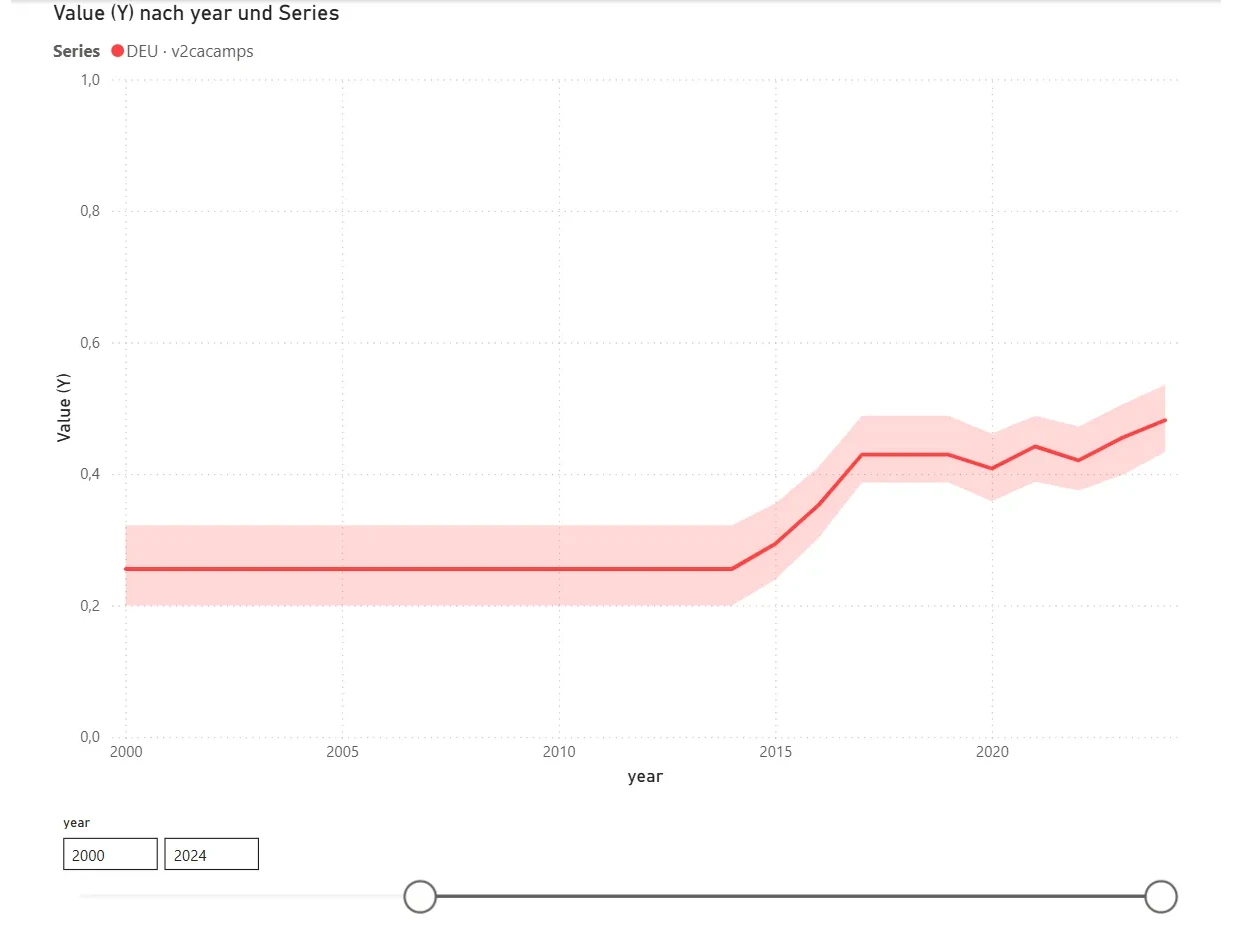
Description. The V-Dem v2cacamps time series for Germany (including confidence interval) displays a long period of relative stability prior to 2014, followed by a persistent upward level shift and increased variance thereafter. The pattern is not episodic; it remains elevated through subsequent years.
Analytical function. This exhibit supports a sustained high-fragmentation equilibrium rather than a crisis-response model. The relevant inference is not that “polarisation increased,” but that the system moved into a higher-fragmentation equilibrium. In such equilibria, marginal external pressure yields non-linear political effects because interpretive and institutional buffers are already thinned. The indicator is used to characterise structural conditions under which decision costs rise; it is not a direct measure of decision latency or governance performance. [7]
The indicator refers exclusively to Germany and is used here to characterise national-level decision-space conditions, not cross-national comparison.
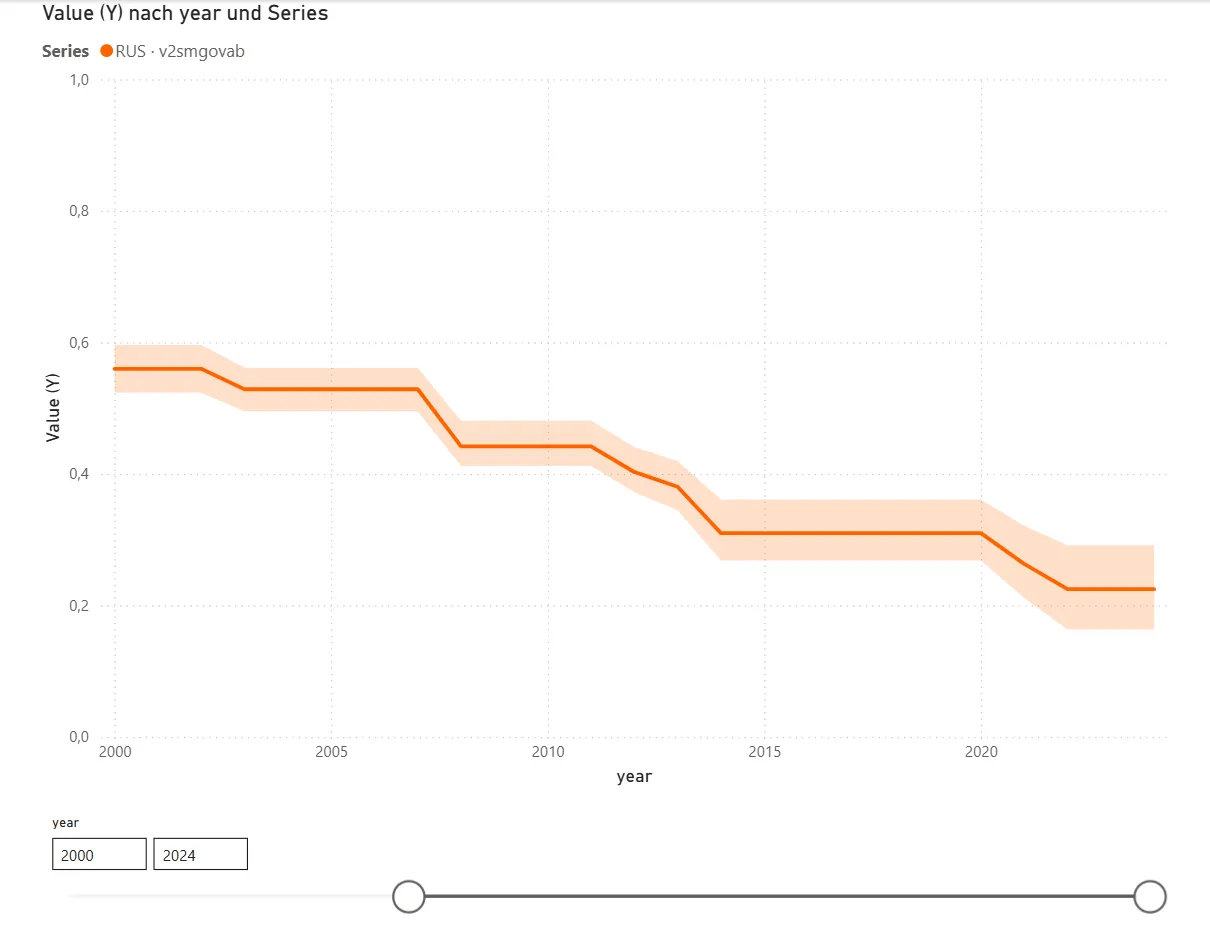
Exhibit F.2 — Russia: Government Media Bias and Abuse Abroad (V-Dem v2smgovab)
Anlage F.3 — Deutschland: Regierbarkeitseinschränkung (INSA Bundestag Sonntagsumfrage, 2023–Dezember 2025)
Description. The V-Dem v2smgovab indicator for the Russian Federation from 2000 to 2024 measures government media bias and abuse directed abroad. It captures the extent to which the state uses media instruments to distort, manipulate, or project narratives beyond its domestic information environment. The indicator is inversely coded: declining values correspond to increasing state bias and abuse. The trajectory shows a progressive descent beginning in the early 2000s, with acceleration after 2012 and consolidation at floor levels by 2022. The pattern is not cyclical; it reflects cumulative capacity-building in outwardoutward-facing information manipulation capacity.
Analytical function. The exhibit establishes an enabling condition on the adversary side. Sustained external information operations require not only intent, but institutional capacity to generate, coordinate, and project narratives across borders over time. The v2smgovab trajectory confirms that this outward-facing media manipulation capacity was consolidated well before 2014 and has since reached saturation levels. This supports an interpretation of continuity and preparedness rather than reactive escalation. [7]
Note. The indicator is inversely coded; lower values indicate higher levels of government media bias and abuse directed abroad.
Exhibit F.3 — Germany: Governability Constraint (INSA Bundestag Sunday Polling, 2023–December 2025)
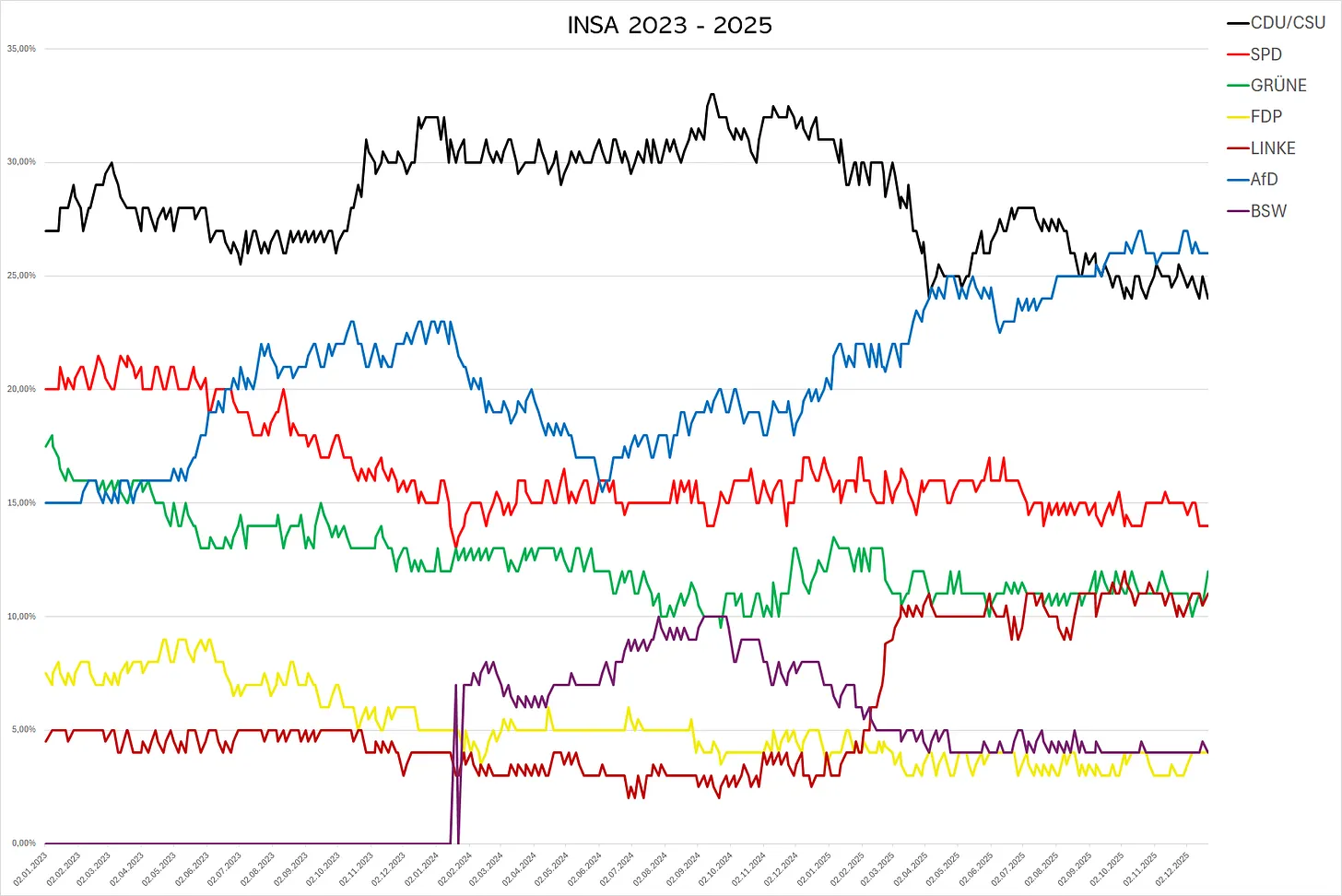
Description. The INSA “Sonntagsfrage” series for Germany’s Bundestag elections displays AfD polling in the mid-20s with persistent shares for Die Linke and BSW. Under that distribution, an AfD share approaching roughly one-third is not simply additional contestation; it functions as a governability parameter shift. Coalition construction becomes arithmetically narrow, strategic decisions become cross-bloc bargaining events, and each such event shifts daily political reality toward normalisation of the anti-system pole.
Analytical function. The result is not necessarily immediate capture of government; it is the systematic reduction of decision latitude, the slowing of strategic tempo, and the expansion of veto points. In such configurations, external pressure can purchase disproportionate effects by increasing decision costs rather than by determining electoral outcomes. [1]
The polling data refer exclusively to Germany and are used to illustrate governability parameters, not voter causation.
G. Decision Architecture
G.1 From Incident Response to Decision Control
Die vorangegangenen Kapitel weisen auf eine strukturelle Diskrepanz zwischen dem diagnostizierten Problem und den im RUSI-Kommentar vorgeschlagenen Lösungsansätzen hin. Wird hybride Aktivität als eine Abfolge von Vorfällen verstanden, so scheinen eine verbesserte Zuordnung, klarere Schwellenwerte und eine abgestufte Vergeltungsmaßnahme ausreichend. Wird hybride Aktivität hingegen als kontinuierlicher Versuch verstanden, die Rahmenbedingungen für mögliche Entscheidungen zu gestalten, so bleibt die Reaktion auf Vorfälle zwar notwendig, ist aber kategorisch unzureichend.
Entscheidend ist nicht die Häufigkeit oder Schwere feindseliger Handlungen, sondern deren Auswirkung auf die Reaktionsgeschwindigkeit, den Zusammenhalt von Koalitionen und die politische Normalität. Sind diese Parameter erst einmal beeinträchtigt, erfolgen selbst korrekte Reaktionen zu spät oder verursachen zu hohe innenpolitische Kosten, um den vorherigen Zustand wiederherzustellen.
Diese Beobachtungen implizieren Anforderungen an die analytische Abstimmung, wenn die Integrität der Entscheidungen unter anhaltendem hybriden Druck erhalten bleiben soll
G.2 Germany’s Constraint as a Systemic Bottleneck
Exhibit F.3 positions Germany as a plausible hinge variable for European strategic capacity under current coalition arithmetic. This interpretation is contingent on institutional configuration and does not imply inevitability. The coupling claim is parameter-based: sustained hybrid pressure can amplify fragmentation and raise governance transaction costs—through recurring shocks, contested attribution, and persistent narrative load—without requiring direct causal claims about voter preference formation. The relevant effect is reduced decision latitude and slower strategic tempo.
As coalition arithmetic tightens and veto points proliferate, the cost of decisive action rises non-linearly. External pressure does not need to win elections; it needs only to raise the internal transaction cost of governing. Germany is used here as an illustrative case under current institutional conditions; the analysis does not preclude other national configurations from exhibiting similar dynamics.
In that environment, hybrid pressure operates as a force multiplier. Each additional incident—cable damage, factory disruption, disinformation spike—adds marginal load to an already constrained system. The cumulative effect is strategic paralysis without a single decisive confrontation.
G.3 Scoping Note
BfV/BND material and RUSI sources referenced in this analysis are used as phenomenology: they document observable patterns of activity. The causal hierarchy inversion—treating decision-space conditioning as primary rather than derivative—is an analytic conclusion of this analysis, not a sourced consensus. The causal ordering advanced in this analysis represents a parsimonious explanatory model derived from observed patterns; it does not claim exclusivity and remains open to empirical refinement.
In this analysis, “decision integrity” is treated as an analytical construct rather than a single observable variable. It can be approximated through a set of proxies, including: decision latency (time from trigger to binding decision), veto-player density (number of effective blocking points), policy reversal frequency (stop–go dynamics), coalition coherence indicators, and shifts in administrative load from strategic planning toward reactive protection and response.
This re-orders causal interpretation; it does not claim doctrinal adoption by Western institutions.
H. Closing Diagnosis
The analysis demonstrates that the Dixon/Beznosiuk commentary collapses under internal scrutiny because its causal architecture is misordered. Using RUSI’s own corpus, the document establishes continuity rather than phase change, effects rather than substitution, and decision erosion rather than threshold breach as the dominant operational pattern. Hybrid and narrative operations emerge not as auxiliary reactions to material decline, but as sustained mechanisms shaping the conditions under which Western political systems decide, coordinate, and act. The decisive analytical finding is not escalation intent, but degradation of decision integrity under persistent hybrid pressure, observable prior to any alleged pivot point.
Final statement
The Dixon/Beznosiuk analysis is falsified by RUSI’s own corpus. The document establishes that sustained hybrid pressure has already eroded Western decision integrity, making the decision-space itself a primary terrain on which strategic effects are already being produced.
Additional analytical material exists that expands the empirical base and comparative scope referenced in this document. Portions of that material are not publicly distributed and are available for qualified review under non-disclosure agreement. Enquiries may be directed to: ed.8d1774558365hcrud1774558365@adn1774558365
Parts of the empirical reasoning in this document originate from The Shape of Now (forthcoming study). The present analysis extracts only what is required to establish the temporal ordering and causal properties relevant to this critique; the full work expands the framework across additional indicators, cases, and comparative systems.