Humans
Narrative Warfare, Plain and Precise
How can one man like Bin Laden shake the United States?
Why do democracies erode today?
How can armies fall without a single shot being fired?
If you want to understand why narratives are weapons — read.
Narratives are not soft power.
Narratives are not manipulation.
Narratives are not disinformation.
Narratives are raw, primordial power. This text is for you.
Prologue
A man. A woman. A child. Meaning.
The father goes out to hunt. Food is scarce. If he fails, hunger arrives. If hunger stays, death follows.
The mother gathers, protects the child, keeps the fire. She holds knowledge — plants, danger, remedy. The future of the family rests in her hands — and that future gives weight to the father’s path.
The child learns by watching. The rhythm of days. The fear of night. The warmth of the mother. The step of the father. It senses: When they act, I live.
Tasks become roles.
Roles form meaning.
Meaning opens access to resources.
It is legitimacy.
Your Content Goes Here
The Group
The best hunter leads the hunt — because he brings food. The best gatherer decides when the clan moves — because she knows the land.
The elders speak when danger rises — because they remember what once was.
Experience becomes a resource.
Knowledge becomes a resource.
Judgment becomes a resource.
This structure is older than language.
It is legitimacy.
The Leader
Sometimes one person sees first. He hears danger earlier. He sees paths others cannot yet see. He decides while others hesitate.
The group follows him not because he is strong — but because his perception creates time: the rarest resource in survival.
His voice carries because it prevents delay.
It is legitimacy.
The War Leader
When danger comes from outside, the one who understands combat leads. He knows when to stand, when to bend, when to disappear. He sees how many enemies approach. He knows when a battle costs lives — or saves them.
In war, the loudest voice means nothing.
Only judgment that holds.
The war leader is not the leader of daily life.
But in crisis his voice outranks all others.
The community entrusts him — with their lives.
It is legitimacy.
The King
Larger communities need shared protection. Someone must speak for all. Someone must decide over land, stores, men, war. A king emerges when people choose to pool their resources: harvest, labor, roads, weapons — and the right to rule them.
They give him insignia so all may see who guards order — and who enforces it.
A king rules because his role binds resource, duty, and protection.
It is legitimacy.
The State
As communities grow, resources must be structured: land, people, taxes, law, defense. Offices arise. Rules arise. Administration emerges — not from bureaucracy, but from the need to hold resources beyond individual lives.
Whoever carries an office carries the right to act in the name of all — because the community entrusts him with its resources.
It is legitimacy.
Churchill
Churchill was not the strongest politician of his time. Not the most elegant. Not the most modern. But he said what no one dared to say:
“I have nothing to offer but blood, toil, tears, and sweat.”
And he gave suffering a meaning.
His words gathered will — a resource.
His stance gathered endurance — a resource.
He became the voice of a nation that had decided to stand.
That is why they followed him.
It is legitimacy.
Hitler
These images gathered resources: attention, followers, willingness to commit violence.
With those resources he seized the state — which opened further resources: police, administration, the military. That this power was turned against his own people does not change the mechanism: People gave the role meaning.
Meaning opened access to resources.
Resources enabled destruction.
It was legitimacy — in its darkest form.
Adenauer
After the collapse, a country stood voiceless. No direction. No anchor. Adenauer did not fill that void with grandeur. He filled it with reliability. He spoke softly — but clearly. He offered direction without illusion.
This gathered the rarest resource of a young republic: trust.
With that trust he stabilized institutions — institutions that then distributed resources: law, order, reconstruction.
This became the foundation on which a country could find itself again.
It is legitimacy.
Monuments
It makes visible what resources built: work, time, sacrifice, belief. He who raises a monument shapes the image of his age.
He who destroys a monument shakes the order it embodies — and the resources bound to it.
It is legitimacy.
Bin Laden
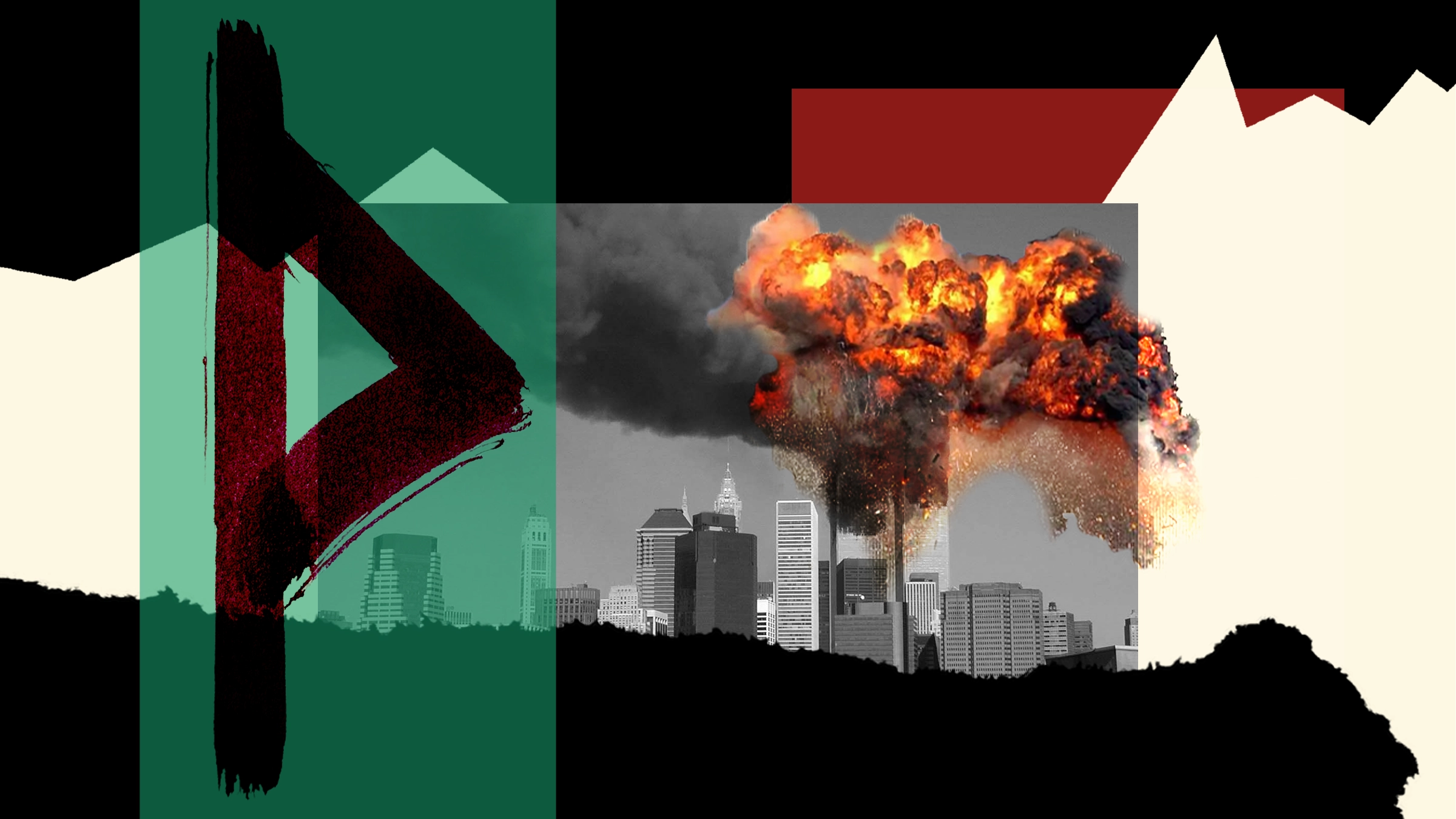
Bin Laden understood that power does not rest only in armies — but in images. He did not attack the United States — he attacked its symbol: height, reach, inviolable safety.
The attack was kinetic — but its effect was symbolic. One man without a state brought down a monument — and with it, the image of an unshakable empire. From that image he drew resources: attention, recruits, money, allegiance.
It was not explosives that made him powerful.
It was the shock that made others see meaning in him.
It was legitimacy.
The New Age
With Bin Laden it became visible that a single man could shake a world power — not through strength, but through meaning.
Then the world accelerated. Not through armies — but through devices in the hands of billions. Social media connected people in seconds. Anger traveled faster than reason. Outrage jumped from screen to screen, and the verdict of the crowd became a resource felt by governments.
Legitimacy shifted: from office to attention. Where expectations grow faster than institutions can answer, a gap forms.
Where the gap grows, a vacuum emerges. And vacuums never stay empty. They are filled by stories that promise what institutions no longer deliver: orientation, belonging, an enemy.
Conflict moved into a new field — decided not only by weapons, but by images, words, and the speed of their spread.
It is legitimacy.
The Mechanics Of Power
Whoever fills a role creates meaning. Meaning becomes recognition. Recognition becomes legitimacy. Legitimacy opens access to resources: time, attention, people, land, money, weapons, institutions.
Resources form the material of power. Power reinforces meaning. Meaning renews legitimacy. A circle — stable or broken.
No one loses power because they are defeated. They lose power because they lose meaning.
Take from a person the story that sustains him — and he loses meaning. Meaning lost becomes legitimacy lost. Legitimacy lost becomes resource lost. Resource lost becomes power lost.
Take from an organization its story — and it loses the right to be heard. Take from a state its image of itself — and its place in the world shrinks. Take from an alliance the narrative that binds it — and you take its will to act.
Who takes the narrative — takes the power.
Welcome to narrative warfare.