
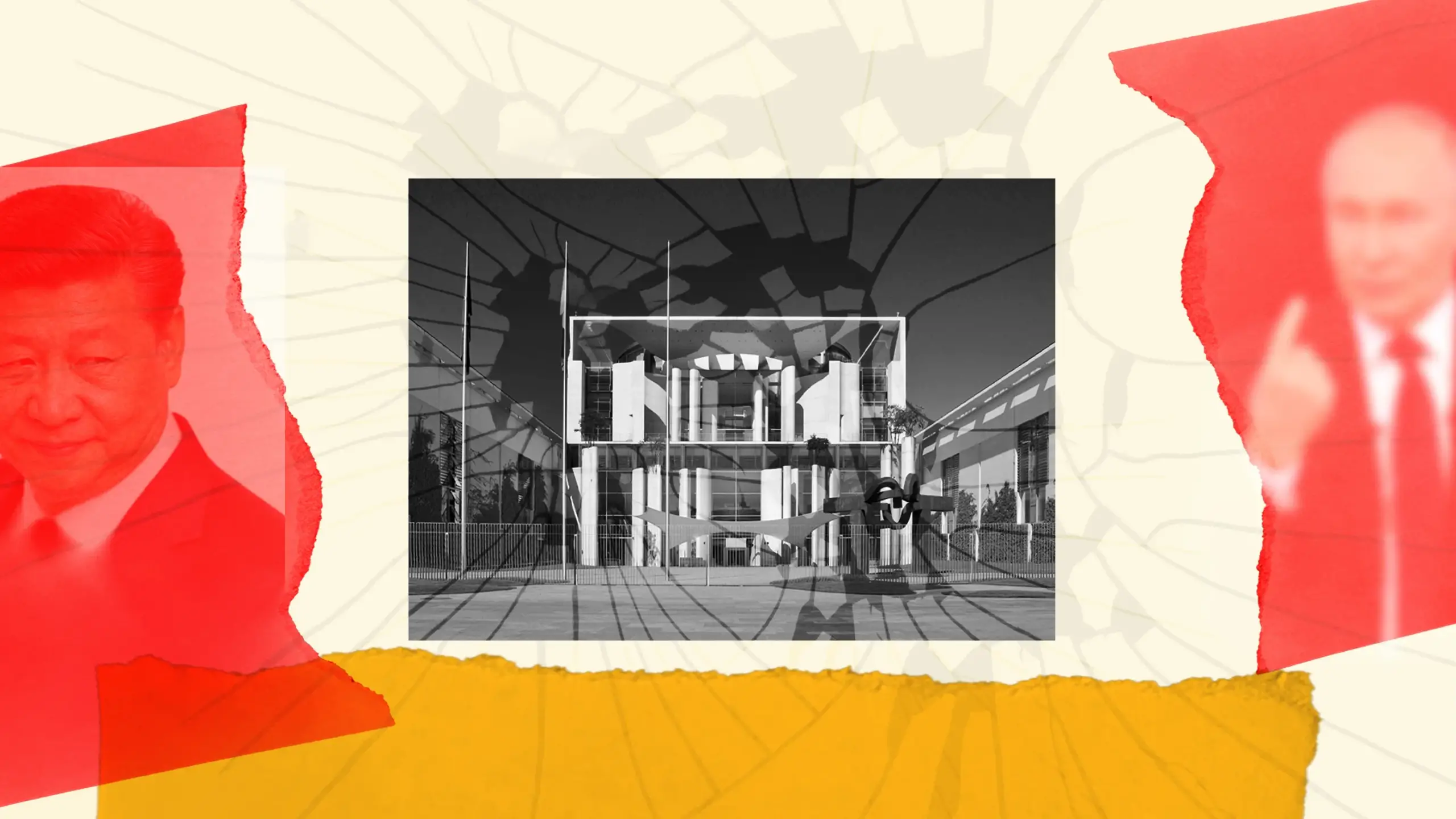
Berlin Negotiation Track
On 14 and 15 December 2025 Volodymyr Zelensky negotiated in Berlin with Donald Trump’s envoys Steve Witkoff and Jared Kushner, hosted by Chancellor Friedrich Merz. US officials offered guarantees like NATO’s Article 5, and Zelensky offered to drop Ukraine’s bid to join the alliance. Russia stayed outside. Afterwards the Americans spoke of consensus on about 90 per cent of their plan. DURCHD8’s brief, written as the talks ended, finds that such rounds move the weight from terms to timing.
Companion Documents
Essay — A readable analytical article framing the subject, context, and significance.
Briefing — The decision-maker’s version: key findings, implications, and operational relevance.
Assessment — A concentrated analytical diagnosis for readers who need the argument.
Architectural Analysis — The complete scientific analysis.

Current State
As of 12 November 2026. Ten months on, no text binds all three parties, and the truces have come by announcement. The track moved from Berlin to Florida and to Paris, where the Coalition of the Willing, Ukraine and the United States adopted a declaration on guarantees on 6 January. Russia joined trilateral rounds in Abu Dhabi in January and February and in Geneva in mid-February. Moscow made Ukraine's withdrawal from the Donbas its condition.
Trump declared a three-day truce for 9 to 11 May, and it ended with more than 200 Russian drones. On 14 September he announced an energy ceasefire, and the Kremlin contradicted him. On 11 October he announced another. Moscow never confirmed it, on 12 October the Kremlin turned down a 60-day truce, and on 15 October Kyiv declared the energy truce over. Nine months after Geneva the three met again, in Abu Dhabi on 10 and 11 November.
Mechanism
The talks had a host, a drafting pair and an absent party. Germany hosted. Washington and Kyiv worked on the text, and the other Europeans aligned and signalled. Moscow commented from outside, its condition set before the talks began: on 12 December the Kremlin’s foreign-policy aide Yuri Ushakov said a ceasefire was possible only after Ukrainian forces left the whole Donbas.
No author was accepted by all sides. In Washington the figure of 90 per cent meant consensus. In Kyiv, Zelensky said on 29 December, it meant that territory and the Zaporizhzhia nuclear plant were still open. Moscow sent no official answer to the draft, and Ushakov announced that its position would be “revised”. The fighting went on throughout.
European governments carry the exposure: high political stakes, many capitals to align and public deadlines shorter than their decision cycles. Early readings settle before any clarification arrives, and later corrections struggle to displace them. The brief finds that the outcome turns on how fast uncertainty falls, more than on the agenda. Where binding meaning stays open, ambiguity itself becomes, in its words, a strategic factor.
At Stake
Ukraine's question is the order of steps. In March Zelensky said Washington would finalise its guarantees once Kyiv agreed to leave the Donbas, and Secretary of State Marco Rubio answered that the guarantees take effect at the end of the war, with no territorial condition. Moscow wants the withdrawal first and a settlement after. The Paris declaration commits a European-led force that deploys only after a credible end to the fighting. Germany gained visibility as host and left the drafting to others. Soldiers on both sides fight on while the sequence is argued.
Who will have the standing to say what the next announced truce binds, and whom?
Political Relations
Washington holds the pen. Witkoff and Kushner carry drafts between Moscow and Kyiv, and Trump announces truces himself. Kyiv negotiates with the Americans, and Moscow reaches Kyiv through them: Russia agreed the May truce by telephone with Washington, which then contacted Kyiv. Moscow keeps its own point of reference, the formula it says was agreed with Trump in Anchorage. On 24 September Zelensky said the talks had left Anchorage behind.
The Europeans guarantee and pay. Britain and France plan the multinational force, Germany hosted the Berlin round, and Friedrich Merz stood beside Zelensky in Kyiv on 4 October. National security advisers from London, Berlin and Paris joined the American and Ukrainian teams in Kyiv in September. Russia’s foreign ministry calls any Western troops sent to Ukraine legitimate combat targets. The Gulf provides the room: Abu Dhabi held the first trilateral rounds, and the next technical meeting may take place in the Emirates.
Research
DURCHD8 wrote Berlin Talks and the Limits of Negotiation on 15 December 2025, as the second day in Berlin ended. The brief works from three dated sources: Reuters on the close of the first day, the Institute for the Study of War on the fighting, and Reuters on the Kremlin’s condition of 12 December. In five short chapters it moves from the frame and the configuration of the talks to the war that went on beside them, to coalition timing and to the structural consequence. It leaves negotiating positions and moral claims unweighed by design, and it marks itself as a reduced analytical layer.
A later study sees the same pattern from the alliance’s side. NATO Consensus as Ceremony records the truce of 9 to 11 May, announced on a private platform and negotiated between Washington and Moscow before Kyiv was formally consulted, with NATO’s council outside the chain.
The brief’s measure can be applied to every announcement since: how long it takes until all three parties confirm the same text. For the energy truce of 11 October the wait ended after four days, without one.