Illustration: © Sabine Mescher
Academia · Civil & NGOs · Corporate · Institutions · Intergov · Media · Non-State · States
Russia · China · NATO · Germany · European Union · Narrative Warfare · United States · RUSI · Ukraine
Russia
Late on 9 October 2026 Vladimir Putin and Donald Trump spoke for an hour and a half, and by the Kremlin’s account “no one wanted to hang up first”. Russia’s war aims stood unchanged. Moscow “will consider when these negotiations can be resumed”. By Putin’s own estimate, Ukrainian strikes on refineries cost Russia about 1 per cent of its output. DURCHD8’s Russia study finds a state that works on the time others need to decide and lacks the means to close a war on its own terms.
Current State
As of 18 October 2026. Moscow fights on and talks on its own schedule. When Donald Trump declared an “energy ceasefire” on 11 October, the Kremlin's spokesman would not say whether Russia had agreed, and within hours a Russian strike hit a power plant in Kharkiv. The next day Moscow rejected a 60-day ceasefire that would have let Ukraine hold a presidential election. Volodymyr Zelensky has since declared the truce over. In a day and a night Russia sent more than 850 drones against Ukraine, by his count, and early on 15 October Ukrainian drones set fire to a refinery in the Ryazan region. The next day Russia's chief of staff told Putin that large-scale strikes on Ukraine's energy system had begun.
The bill shows in Moscow's budget. Oil and gas revenue fell by a sixth in the first eight months, the deficit had already passed the plan for the whole year, and the European Commission counts more than two thirds of the liquid assets of the sovereign wealth fund as spent. Western pressure runs in two directions. Washington exempted Russian diesel already loaded on tankers from its sanctions until April 2027, and on 12 October the EU listed 1,569 more people and companies of Russia's arms industry. Both presidents want to attend the APEC summit in Shenzhen on 18 and 19 November, the next date both have in view.
Mechanism
The machinery behind this posture is older than the war. The KGB kept a service for active measures, a directive under Yuri Andropov made them a central task in 1982, and with East Germany’s Stasi it planted the false claim that AIDS was man-made in the press of the non-aligned world. The craft survived the 1990s in the FSB, the SVR and the GRU. A decree of 2016 declares information a field of national security, and three federal laws let the state block sites, filter the network and brand people as foreign agents. Each time the practice came first: operations against Estonia in 2007 and Georgia in 2008 before the doctrines, the censorship of February 2022 eight days before the law. Since 2012 the same three stories have run through the president’s speeches, state television, diplomacy and proxy channels: the West encircles Russia, preaches what it breaks and leaves Moscow only defence. Oil and gas rents pay for the apparatus.
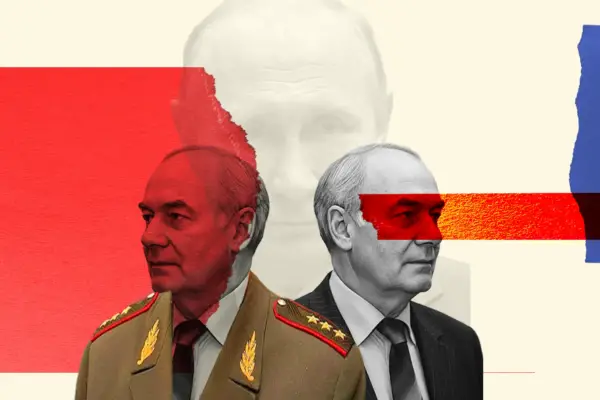
Brussels and Moscow read the same budget. The European Commission writes that it is “under growing pressure”. The Kremlin calls the deficit “a moving figure”. A RUSI commentary read the sabotage in Europe as the act of a desperate Russia, and DURCHD8 found the campaign under way since 2014. Its Ivashov study shows what that reading does: a capital that expects Moscow to give out soon puts off what takes years to build. Moscow works on what others can decide, and when.
At Stake
Kyiv pays first, in light, heat and water. Since late September Russian strikes on the grid have cut the capital's power for hours each day and twice stopped its underground trains, while the dates of any talks are set in Moscow. In Brussels the cost is speed. Every sanctions package needs all twenty-seven governments. In April Slovakia held up the twentieth with its veto, as DURCHD8's NATO study records. On the Baltic, Putin calls NATO's exercises escalation and says a direct attack on Kaliningrad would raise the question of Russia using “all the weapons at its disposal”. NATO bears the cost the Russia study names: the warning still arrives, and the decision comes too late or too divided to answer it.
Which will run out first, the rents that pay for Moscow's machinery or the unanimity Europe needs to keep its sanctions?
Political Relations
Washington talks to Moscow directly and presses Kyiv. The call of 9 October covered Russian oil products, Iran and the war while Ukraine’s negotiators sat in Miami, and according to a person cited by Reuters the United States threatened to cut intelligence sharing and arms purchases for Ukraine to make it halt strikes on Russian energy sites. Kyiv says it was then denied the usual warnings of Russian ballistic missiles. Trump says the sharing has not stopped.
The EU expects to lend Ukraine 90 billion euros for 2026 and 2027, and each of its sanctions needs every member. Russia’s ties run south and east. A treaty signed early in 2025 binds it to Iran, Moscow offers to take in Iran’s highly enriched uranium, and DURCHD8’s NATO study found Chinese dual-use parts replacing Iranian supplies in Russia’s drone production after April 2026. In shells the balance favours Moscow: by Estonian intelligence estimates it was making 7 million rounds a year by early 2026, against about 2 million from the EU’s programme. Its coherence is imposed from the top. It holds until it breaks, as the Wagner mutiny showed in June 2023.
Research
DURCHD8 reads Russia from its own papers. Russia’s Information Domain as a Governed Power Function rests on the security doctrine of 2016, three federal laws and American court records of 2018, and it admits other literature only where it reproduces them. The analysis closed in October 2025, appeared on 17 May 2026 and is deposited at Zenodo. It named what would refute it: operations that stop once a single actor is sanctioned, laws that bind the state on the terms they impose on others, and a statute that came before the practice. None had occurred when it appeared, and the record since fits its order: a whitelist for mobile shutdowns was in use by September 2025, months before the Duma approved a bill letting the FSB order them.
Five studies test the reading on single cases. Ivashov: Signal Within a Governed Information Environment follows a voice the state lets speak, and Hybrid Warfare Is Already Working holds a RUSI forecast against RUSI’s own record. NATO Consensus as Ceremony sets Russia’s imposed coherence beside the alliance’s consensus, and Berlin Talks and the Limits of Negotiation watched talks held without Russia at the table. Zeitenende: Macht ohne Bedeutung ist bedeutungslos follows Russia’s operations in Germany since 2014: they amplify fault lines opened at home and add friction at thresholds such as elections.
The study names the money behind the apparatus, oil and gas rents, which Russia’s finance ministry reports monthly.