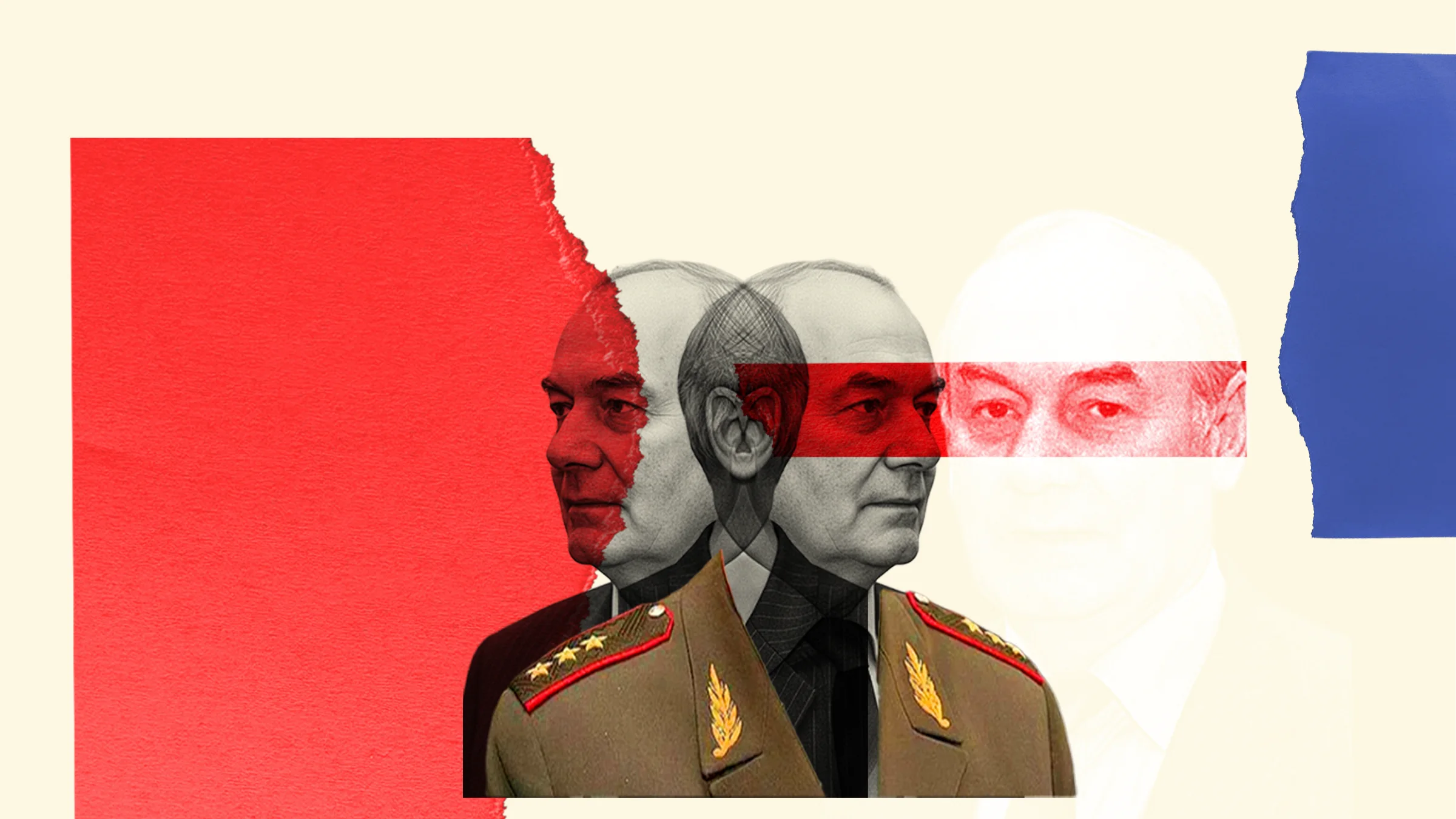

STRATEGIC ASSESSMENT
Ivashov:
Signal Within a Governed Information
Environment
The Ivashov stream operates as a regime-permitted external expectation-management channel: elite-grade, bounded, persistent without suppression, structurally coupled to negotiation-salient phases. The classification is functional, not attributional; it follows from cost-structure logic in a security state with documented outward-facing media architecture, not from claims about a named tasking chain.
Frame and Standard
This assessment is the mid-length companion to the Architectural Analysis (DURCHD8-IVA-2026-001). It diagnoses the Ivashov communication stream—Col-General (ret.) Leonid Ivashov’s outward-facing video and Telegram output across the Geoanaliz YouTube channel1 and the IvashovLG Telegram channel2—as a narrative artefact within a governed information environment. The evidentiary standard is structural sufficiency under maximal repression, not attributional certainty about handlers, tasking chains, or named units.
The case is treated forensically rather than statistically. The classification advanced here is functional—compatibility with regime objectives under active governance—and is held independent of claims about named actors, command paths, or scripted messaging. Sources include three Russian-language transcripts held in the case folder, open-source biographical material on the actor,3 the Varieties of Democracy dataset and codebook,4 the Freedom House country assessment,5 institutionally conservative literature on Russian hybrid and grey-zone activity,6 and the DURCHD8 falsification of the RUSI 2026-hybrid-escalation thesis.7
The analytical cut-off is 1 January 2026. Events after that date do not enter the analysis. References to the 2023 platform-blockade phase and to subsequent diplomatic markers concern indicator series and institutional acts established within the cut-off window, not post-cut-off events.
Finding F1: Structural Alignment Under Maximal Repression
Finding. The Ivashov stream persists in a system that has both coercive capacity and information-governance capacity at scale, with elite-grade content and stable bounds, and without observable suppression. In such a system, that combination implies regime-level evaluation and permissibility governance.
Mechanism. Russia’s information governance is codified in a series of acts—the Foreign Agents Law of 2012, the Doctrine of Information Security of 2016, the Sovereign Internet Law of 2019, and the platform-blockade consolidation of 2023.8 The outward-facing arm was reorganised by Presidential Decree No. 894 of December 2013 into the Rossiya Segodnya holding (Sputnik, RT).9 The fiscal substrate of this build-up is documented in standard IMF and World Bank reports.10 V-Dem indicator architecture (v2mecenefm, v2mecenefi, v2mecrit, v2x_freexp_altinf, v2smgovdom, v2smgovab) operationalises both inward-control and outward-projection capacity as measurable variables.11 Under this configuration, sustained elite-grade external messaging is not residual speech but a managed asset or a managed risk.
Channel properties. The Ivashov stream exhibits four stable signatures: (i) an actor profile rooted in documented senior MoD roles, including international military cooperation during the 1990s, operating in a post-active-duty register that converts retained rank into analytic standing;12 (ii) boundedness through a consistent desk-address format, interpretive closure, and absence of domestic mobilisation cues—semantically the content is unambiguously oppositional (explicit attribution of war-trajectory responsibility to Putin, regime failure in science and education, population decline as Russia’s only standing achievement)13, yet the speaker continues to live and broadcast under discreditation statutes that have produced detention for less senior figures; (iii) a multi-platform distribution layer (Geoanaliz YouTube;14 IvashovLG Telegram;15 third-party re-distribution16) with views materially exceeding subscriber-conversion, embedded crowdfunding routing (Sberbank/Tinkoff/Bitcoin) and an unrelated medical-clinic insert layer—bottom-up and self-financing rather than visibly state-allocated; (iv) temporal alignment of upload timing with negotiation-salient moments in the 2025 diplomatic cycle.17
Falsifier. The finding would be falsified by directly observable disciplinary action against Ivashov personally or against the Geoanaliz studio combined with non-resumption of the channel: a raid; a Foreign-Agent designation under the 2012 statute; account suspension by Roskomnadzor under the Sovereign Internet authority; criminal proceedings under the 2022 discreditation statute. Alternatively, the finding would be falsified by uniform suppression of comparable elite-grade outward-facing voices across the same window, demonstrating non-selective regime practice; or by a clearly random tolerance trajectory inconsistent with stable signal bounds. Across the observable window through 1 January 2026, none of these patterns is registered.
Finding F2: Strategic Utility Class – Decision-Space Conditioning
Finding. The Ivashov stream is structurally fit for an effect class consistent with decision-space conditioning of adversary systems—specifically, the degradation of decision integrity through latency, coalition friction, and shrinking governability margins—rather than for persuasion of mass audiences or for mobilisation of domestic constituencies.
Mechanism. The relevant metric for contemporary narrative warfare is the integrity of adversary decision systems, not opinion change. This framing, established in the DURCHD8 falsification of the RUSI 2026-hybrid-escalation thesis,18 is consistent with RUSI’s own descriptions of Russian hybrid activity as targeting cohesion, ambiguity, and governance friction rather than escalation thresholds.19 On the Russian operational side, the analytical tradition of structuring adversary decision-making through calibrated information exposures is documented across the continuity-claims literature on Soviet and post-Soviet active-measures practice.20 The dominant motif in the Ivashov stream—Russia portrayed as strained, internally brittle, or approaching systemic exhaustion—produces three predictable effects in Western decision systems: negotiation fixation (the framing of negotiation as urgent and morally preferable); de-risking over re-arming (the preference for risk reduction over irreversible commitment); and temporal discounting (the political discounting of strategic investments with delayed payoff).
Cost–risk asymmetry. The channel’s cost structure is asymmetrically favourable to the regime: negligible operational cost, no domestic mobilisation, no irreversible claims, no escalation triggers. Under such cost–risk conditions, even probabilistic utility is sufficient to justify evaluation and permissibility in a rational security state. The regime does not need certainty of benefit; it requires acceptable expected value under low risk.
Western reception is not uniform. The classification task arrives differently in different capitals: Berlin, Paris, Warsaw, Vilnius, and Helsinki carry divergent national analytical traditions for Russian information-operations architecture and distinct routinisations of channel-class diagnosis across national services. The German behavioural-architecture for such diagnosis runs through the Federal Office for the Protection of the Constitution (BfV) and the Federal Intelligence Service (BND) plus the foreign-policy desk of the Federal Foreign Office and the situation centres of the Federal Ministry of Defence; the equivalent French, Polish, Finnish, and Baltic architectures each operate on different statutory anchors and different research-institute relays. The transatlantic configuration since January 2025 has reorganised the frame in which a channel-class diagnosis operates; the channel travels across the resulting Anglo-American versus continental-European asymmetry in standing operational vocabulary (active measures as a default category in the US tradition since the 1980s Mitrokhin-period; later and more contested institutional anchoring in continental European services) without resolving it.21 Cutout-aligned channels of this class reach Western intelligence and policy-analysis services through different reporting routes than licensed regime channels and trigger different bureaucratic handling; the diagnostic standard developed here applies in both cases, the operational implications diverge accordingly.
Falsifier. The finding would be falsified by either (a) empirical demonstration that the channel’s content does not produce decision-space effects of the named class in the observable Western response space, or (b) a structural shift in channel output that violates the boundedness signature (calls to domestic mobilisation; escalation cues; irreversible commitments). Neither has been observed within the cut-off window.
Finding F3: Coordination Necessity (Mx)
Finding. The persistence of an elite-grade, bounded, outward-facing channel under maximally repressive conditions implies a regime-level coordination function (denoted Mx) capable of classifying narrative outputs by effect class, evaluating expected value and downside risk, governing permissibility, and retaining intervention capacity in case of deviation.
Sub-function specification. Mx need only carry four functions: classification (distinguishing destabilising/neutral/externally useful outputs), evaluation (expected value and downside risk), permissibility governance (allow/bound/tolerate/suppress/terminate), and intervention capacity (act on deviation). The four sub-functions are functional, not departmental; each draws on a distinct register of state power. Classification is ideological-cognitive work over regime-anchored frames; evaluation is interagency analytic work spanning political and military registers; permissibility governance is political (the prerogative of allowing or terminating elite-grade outward speech); intervention capacity rests on the coercive apparatus (regulatory bodies, security services).
Open actor-model. Three actor-models are equally compatible with the structural facts: a bureaucratic-coordinative model (Presidential Administration plus Security Council operating across departments), a personalist model (concentrated authorisation by a small inner circle), and a competitive model (overlapping authorities at the Presidential Administration, General Staff, and security services, with Mx as the operational intersection at which a channel either persists or does not). The structural-sufficiency standard holds across all three: persistence implies an evaluative function regardless of which institutional model carries it. The institutional substrate documented in the architectural analysis (Annex 1) is the most direct historical instantiation of the bureaucratic-coordinative model and does not falsify the personalist or competitive alternatives.
Mechanism (selective repression). Russia exhibits selective repression, not uniform repression. V-Dem indicators document a step-change in censorship effort (v2mecenefi) and domestic propaganda (v2smgovdom) following the Bolotnaya protests and the Foreign Agents Law; a further codified phase with the Doctrine of Information Security (2016) and the Sovereign Internet Law (2019); and the platform-blockade consolidation of 2023.22 Across the same window, outward-facing media capacity (v2smgovab) was expanded. The Russian system did not become uniformly silent; it became architecturally selective. Selectivity is the operational form of the evaluative mechanism the case requires. The formal structure (Foreign Agents Law, Doctrine, Sovereign Internet Law) would predict either suppression or full state authorship of elite-grade outward speech; the observed practice (selective persistence of bounded high-credibility channels) sits at a distance from that formal prediction. The distance is institutional decoupling.23
Falsifier. The finding would be falsified by demonstration that an equivalent regime-class system tolerates uncontrolled elite-grade outward channels at scale without any evaluative function, or by structural evidence that the Ivashov channel is operationally outside the Russian information-governance perimeter (which the V-Dem indicator series and the documented legal architecture do not support).
Finding F4: Absence of Viable Alternative Explanations
Finding. The three principal alternative explanations to regime alignment fail under the actor profile, system constraints, and observed effects taken together.
Alternative 1 – Independent entrepreneur. Fails under actor profile and system constraints. Given Ivashov’s background and Russia’s information-governance configuration, market-optimised content creation is structurally implausible; it conflicts with persistent boundedness and apparent tolerance.
Alternative 2 – Genuine destabilising dissident. Fails under boundedness. A credible insider repeatedly claiming imminent regime collapse would ordinarily generate domestic risk—elite panic, deterrence distortion, loss of control. The observed output systematically avoids domestic mobilisation and operates with stable bounds. This is consistent with effect-bounded speech, not with destabilising dissent. The assessment is restricted to externally legible dissent with international reach; tolerated domestic pessimism follows a different risk calculus.
Alternative 3 – Accidental tolerance. Fails on cost asymmetry. In a high-control system, accidental tolerance of a high-credibility narrative node is not a stable equilibrium; the downside risk of uncontrolled deviation is too large for a rational security state to ignore. The requirement is evaluative capacity, not micro-tasking.
Residual alternatives. Three live alternatives remain: licensed/permissioned alignment (regime evaluation plus permissibility bounds without daily tasking), factional signalling (internal elite conflict using outward channels), and cutout alignment (semi-autonomous nodes operating within understood red lines). All three imply a governing function capable of classifying risk and effect. Factional signalling at this level still requires tolerance by security services, boundedness enforcement, and assessment of external spillover effects; the gatekeeping function persists.
Falsifier. The finding would be falsified by demonstrating that any of the three eliminated alternatives is in fact compatible with the joint constraints of actor profile, system architecture, and observed effects. The full architectural analysis examines the elimination logic at length (Section C.6).
Phase-Shift Trajectory 2022–2025
The four observable channel properties are stable across the analytical window. A qualitative reading of the output across three operational phases registers direction without converting the temporal-alignment claim into a quantitative empirical demonstration.
2022 wartime-censorship phase. Following the introduction of statutory penalties for “discreditation” of the armed forces, the channel exhibits a cautious signature on YouTube/Geoanaliz and a denser, more operational signature on Telegram/IvashovLG. Post-upload removals are observable, consistent with operator-side boundary testing under a new censorship regime. The boundary-testing pattern is institutional decoupling in operation: the formal censorship structure coexists with a permissive operational practice. The phase expectation horizon is rapid resolution; the channel’s statecraft register accompanies initial-stage crisis communication.
2023 Runet-closure and platform-consolidation phase. The public-platform signature stabilises and shifts toward Western-policy critique as the dominant content cluster. The channel transitions from reactive caution to a consistent register that uses elite military credibility to authorise a state-aligned critique of Western strategic positioning. Cross-platform synchronisation increases. The expectation horizon shifts from rapid resolution to protracted-war adaptation; the channel’s statecraft register accompanies consolidation communication.
2025 negotiation-salient phase. Channel weight moves toward security-doctrine assessment, with content clustering around major diplomatic markers: the January–February US-mediated talks, the May Istanbul direct talks, the June draft-memorandum exchanges, the August Alaska summit, and the autumn debate over a US-proposed 28-point peace plan.24 Cross-platform synchronisation is high; upload density rises near the diplomatic markers. The expectation horizon is diplomatic consolidation under negotiation pressure; the channel’s statecraft register accompanies position signalling around the negotiation calendar.
The trajectory is consistent with state-aligned content stabilisation across the window, not with mode-migration into mobilisation. A formal time-series test of upload timing against negotiation-salient events, with baseline frequency model and counterfactual comparison, remains pending; the qualitative direction is registered, the quantitative demonstration is open.
Three Modes of Legitimacy in Permissibility
The permissibility invoked across the analysis is a legitimacy condition. The standard organisational-theory distinction separates three modes: pragmatic legitimacy (compatibility with the evaluator’s interests), moral legitimacy (compatibility with the evaluator’s values), and cognitive legitimacy (the taken-for-grantedness of a pattern).25 The Ivashov channel persists under all three, in distinct registers.
Pragmatic legitimacy is the load-bearing mode: under the cost–benefit logic developed in Finding F2, the channel is acceptable expected value at low risk. Moral legitimacy is present derivatively: the channel’s themes operate inside the outward-facing master-narrative architecture (the Russkiy Mir frame and the “protection of Russian-speakers” template) without invoking those frames directly, which keeps moral-frame compatibility intact at the systemic level.26 Cognitive legitimacy is the substrate: against the background of the besieged-fortress narrative documented across the V-Dem indicator series and the codified information-governance phases, an elite-grade voice reporting on adversary intent is a culturally available form, not a rule violation.
The three modes are co-present, not exchangeable. Cognitive legitimacy in particular sits on a horizontal field-recognition layer that runs parallel to the vertical permissibility relation: the besieged-fortress register and the elite-credentialed analytic format are recognised as available forms inside Russian security-policy peer networks and inside the off-platform Western analyst circuits through which the channel travels. Mx’s permissibility decision does not have to constitute that recognition; it operates against a recognition substrate that the field reproduces on its own. The vertical evaluative function and the horizontal recognition layer are complementary components of channel persistence.
The companion architectural analysis on Russian information governance (Sauer 2026, pending) applies the same Suchman framework on an effect side: cognitive register against external decision-frame erosion in open political systems; pragmatic register for internal stability legitimation; moral framing activated selectively at flashpoints. Vertical permissibility-decision here and effect-side propagation there are two readings of the same governance apparatus, both consistent with the load-bearing role of pragmatic legitimacy on the regime side.
Comparative Substrate and Transferability
The analytical architecture is not Russia-exclusive. The conditions under which it applies—codified information-governance capacity plus institutional outward-facing media architecture plus selective rather than uniform repression—are present in other contemporary regimes in differently weighted forms. The architectural analysis registers six structural-pattern analogues: post-Mao China through the “telling China’s story well” framework, with Hu Xijin (former Global Times) and Wang Wen (Chongyang Institute, Renmin University) as two distinct registers;27 post-revolutionary Iran in the mardomsalari dini framing, with M.-J. Larijani (High Council for Human Rights) and H. Mousavian (Princeton SGS) as institutional and academic registers;28 and two historical Western precedents—UK MoD/FCO use of RUSI and IISS during the 1982 Falklands campaign,29 and the CIA-funded Cold War architecture of the Congress for Cultural Freedom and Radio Free Europe / Radio Liberty.30
The six cases vary materially in channel tempo. Hu Xijin, Wang Wen, Larijani, and Mousavian operate as standing channels (continuous outward-facing functions across years or decades). The UK use of RUSI/IISS in 1982 was a crisis-temporary architecture condensed into roughly a 74-day operational window. The CIA-funded Cold War architecture operated across the entire Cold War as a multi-decade clandestine structure. The shared structural function—an outward-facing voice operating inside an allowed effect envelope, carried by a non-state-attributed institutional location—is the substrate the Ivashov determination rests on. The differences register the limits of cross-case generalisation: each case instantiates the structural function at a different time scale and risk envelope, and the comparison establishes pattern recurrence rather than equivalence. A full comparative study extending each case along the dimensions of the architectural analysis (Section C.6, alternative-explanation discipline) is the natural next analytical step.
Standing Open Items
Ten categories of analytical work would upgrade confidence in the determination beyond the structural-sufficiency standard applied here.
- Event-clustering analysis (open). A formal time-series test of upload timing against negotiation-salient events, with baseline frequency and counterfactual comparison.
- Amplification pathway mapping (partially constrained). A structured trace of early-repost clusters and seeding pathways across professional and semi-professional security-policy networks.
- Reach–conversion anomaly detection (open). A windowed comparison of view-count distributions versus subscriber-conversion rates against comparable channels in the same content class.
- Mode-migration of the channel (partially constrained; conditional). Whether the channel migrates from the bounded outward-facing mode into a mobilising or escalation-signalling register under specific stress conditions—a hard pivot in negotiation, a regime-internal consolidation crisis, or a new kinetic escalation cycle. Active testability arises when one of those stress conditions materialises within the observable window.
- Legitimacy-mode trajectory over time (partially constrained). Whether the three modes carry the channel in equal proportion across phases or whether the modus weighting has shifted. The phase trajectory in Section 6 suggests a shift toward stronger cognitive-and-moral weighting in the 2025 phase; a formal test through structured content coding remains pending.
- Audience-cross-jurisdictional legitimacy (open). The audience complex decomposes into at least three sub-fields with distinct recognition dynamics: the Russian domestic public on Geoanaliz and IvashovLG (regime-aligned cognitive frame); the Western OSINT-aggregator layer that picks the content up at short lag (technical-translational frame); and the Western think-tank and policy-analysis discourse that processes the content over days to roughly a week (analytic-interpretive frame). A structured analyst-network mapping of the three transmission stages is pending.
- Western analytic capacity for channel-class diagnostics (open). The Russian outward-facing media architecture has been scaled at institutional level across the analytical window. Western capacity for routinised diagnosis of regime-permitted external expectation-management channels sits below the corresponding adversary investment in the channels themselves. A capacity-asymmetry mapping across NATO and EU member states remains pending.
- Channel-operation logistics (open). The distribution-signature (views materially exceeding subscriber-conversion) implicates an operational substrate—hosting, cross-platform amplification routines, repost-network coordination—that the present analysis does not reconstruct. Empirical mapping across the analysis window would quantify the off-platform distribution mechanism.
- Anglo-American vs. continental-European diagnosis asymmetry (open). The US intelligence and policy-analysis tradition has carried active measures as a standard analytical category continuously since the 1980s Mitrokhin-period; German and French analytical traditions have a different institutional anchoring. A mapping of how this transatlantic asymmetry shapes reception of channel-class outputs in different Western capitals remains pending.
- Internationalisation of the classification method (open). If a channel-class diagnostic protocol of the kind developed here were standardised across Western services, the architecture of that standardisation—NATO StratCom CoE, EU EAD, Five-Eyes equivalents—would be an institutional question with its own constraints, registered here without addressing it.
These items are registered so that their status is explicit; the present classification does not depend on full discharge of any of them.
Closing
Under conditions of maximal repression and selective tolerance, sustained elite-grade narrative output cannot persist without regime-level evaluation and permissibility governance. The Ivashov stream satisfies all conditions that trigger such evaluation: high credibility, external reach, repetition, temporal coherence, and potential downside risk. The decisive point is not whether the messaging is centrally scripted, but whether it operates within an allowed effect envelope. The evidence assembled across the four findings establishes that it does.
The most parsimonious and structurally consistent classification under these constraints is functional regime alignment. Any alternative would require either the absence of evaluative capacity in the Russian system or a tolerance of uncontrolled elite signalling—both contradict the documented record. The classification is held in a strictly functional sense (compatibility with regime objectives under active governance) and does not extend to claims about command chains, tasking, or scripted authorship.
The operative response question is not regulatory but institutional. The classification produced here is an analytical tool; its institutional value depends on whether liberal-democratic policy systems recognise a regime-permitted external expectation-management channel as such without sliding into denial, counter-mobilisation, or panic. That disciplined recognition is the resilience question for systems that govern themselves through open deliberation under adversarial cognitive pressure. The recognition is institutional before it is regulatory: it sits in standing operational vocabulary, in analyst training, in the routinisation of channel-class diagnosis across services—not in the choice of any single counter-measure.
Contact: ed.8dhcrud@ofnidurchd8.com
Companion Documents
Essay — A readable analytical article framing the subject, context, and significance.
Briefing — The decision-maker’s version: key findings, implications, and operational relevance.
Assessment — A concentrated analytical diagnosis for readers who need the argument.
Architectural Analysis — The complete scientific analysis.