
Illustration: © Sabine Mescher
Academia · Civil & NGOs · Corporate · Institutions · Intergov · Media · Non-State · States
Across dossiers: Russia
Leonid Ivashov Analysis
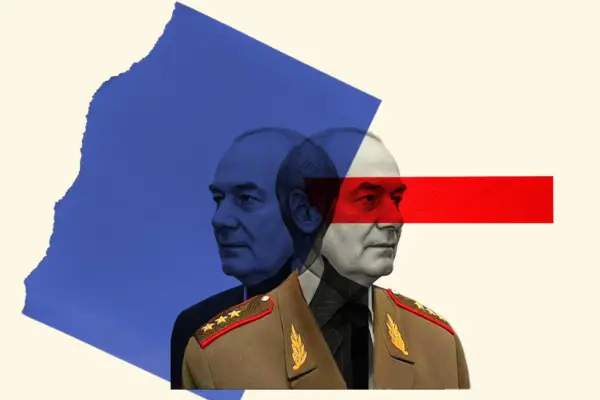
Leonid Ivashov sits at a desk in front of dark bookshelves. The camera never moves. On 15 August the retired colonel general asked whether the Duma election would stop “the collapse of Russia”. By 13 October the talk had drawn 245,405 views, three times the channel’s 81,300 subscribers. Others have gone to prison for words like his. DURCHD8’s study classes the channel as a voice the state permits, whose talk of collapse lands in Western capitals and shortens the time they think they have.
Companion Documents
Essay — A readable analytical article framing the subject, context, and significance.
Briefing — The decision-maker’s version: key findings, implications, and operational relevance.
Assessment — A concentrated analytical diagnosis for readers who need the argument.
Architectural Analysis — The complete scientific analysis.
Current State
As of 18 October 2026. Nine months after the analysis closed, the desk is still on air, and none of the events that would refute the study has been reported. On 21 September a talk ran under the title “Missiles on decision-making centres: what the West is secretly preparing the world for” and passed 200,000 views. In August the description under one talk listed Max, the messenger the state promotes, beside his Telegram feed. In March the online magazine Republic ran an interview headlined “We turned out to be idiots”, in which he called Russia's international position as bad as it gets and the aims of the “operation” failed.
The law kept reaching others. In July the justice ministry listed Boris Nadezhdin, the only anti-war candidate for president in 2024, as a foreign agent. In August a court in Pskov sentenced Lev Shlosberg of Yabloko to eleven years and a month for “discrediting” the army and spreading “fake news”, partly over a debate in which he called for a ceasefire. The study names every round of talks as its next data point. On 9 October Putin told Trump that Moscow “will consider when these negotiations can be resumed”.
Mechanism
The stream speaks with two voices. One says Russia is broken: science and education in ruins, its only lead in population decline. The other says the West is overstretched and losing its grip. A listener who takes the channel as dissent hears the first, and one who takes it as the regime’s voice hears the second. The study reads what the halves do together. Criticism of Putin buys credibility with Western analysts, who cannot file the speaker as a spokesman. The talk of collapse then works in their capitals: negotiation looks urgent, rearmament looks late, and the next decade is costed shorter.
Rank carries it. In the 1990s Ivashov headed the defence ministry’s main directorate for international military cooperation, and readers abroad give his words the weight of that office. Beneath the stream run donation details for Russian bank cards and a Bitcoin address, and between sentences on the state of the world an advertisement for a private clinic. The study counts such bottom-up rails as the signature of a cutout. Control sits upstream, in deciding which effects may circulate, and authorship stays with the speaker. In a state that jails others for such words, what it leaves on air is its choice.
At Stake
The cost lands first at the negotiating table. A negotiator who discounts a Russian position because a credible general says collapse is near produces the effect such a channel is fit to produce. Analysts face a question of method. Read by tone, the general is a dissident. Read by effect, he belongs to the conversation the state permits, and waiting for a named handler before classifying him lets the useful window pass. People in Russia live with the line between the permitted and the punished, drawn case by case and visible only in its results: a desk in Moscow, eleven years in Pskov.
Who in a Western service classifies a voice like this before the next round of talks, and on what evidence short of a named handler?
Political Relations
At the centre stands Leonid Ivashov, born in 1943, a retired colonel general who reaches his audience through the YouTube channel Geoanaliz and the Telegram feed IvashovLG. Sometimes a co-host in a sweater sits across from him, and third-party channels recut his talks under sharper titles. Donations run through Russian bank cards and a tipping service, and signed copies of his books are for sale.
Above him stands the state. The study describes a function that sorts voices by effect, weighs risk and keeps the power to intervene, and it leaves open whether that function sits in the presidential administration with the Security Council, in a small circle around the president or in the overlap of rival agencies. Abroad the stream moves in three steps: to open-source aggregators within hours, to think tanks within days, to mainstream policy analysis within about a week. Behind the general stands a line of Soviet and Russian voices for the outside world, from Vladimir Pozner in the television spacebridges of the 1980s to Sergei Karaganov today. Beijing had its counterpart in Hu Xijin, for over a decade the loud voice of the Global Times.
Research
The analysis appeared in four documents on 17 May 2026, with a cut-off of 1 January 2026 and three Russian transcripts from the channels as its source. Ivashov: Signal Within a Governed Information Environment is the full study of about 58 pages, archived on Zenodo. It asks what must be true for such a voice to persist under maximal repression and tests the alternatives: an entrepreneur, a genuine dissident, an accident of tolerance. Each fails on the facts of the case. At the cut-off it named what would refute it: a raid on the studio, a foreign agent listing, a suspension by the regulator or a prosecution under the discreditation law with the channel falling silent, or the same silence imposed on every comparable voice. It also lists the work still open, among it a count of upload dates against the dates of talks, a map of who reposts first and a comparison of views with subscribers. A structural assessment sets out mechanism and refutation finding by finding, The Ivashov Channel as Regime-Permitted Expectation Management corrects six assumptions for senior staff, among them that crowdfunding proves independence, and Moscow, Late 2025: A General, A Desk, A Permitted Voice tells the case from the desk outward.
The open timing test needs only two calendars, the channel’s and the negotiators’.