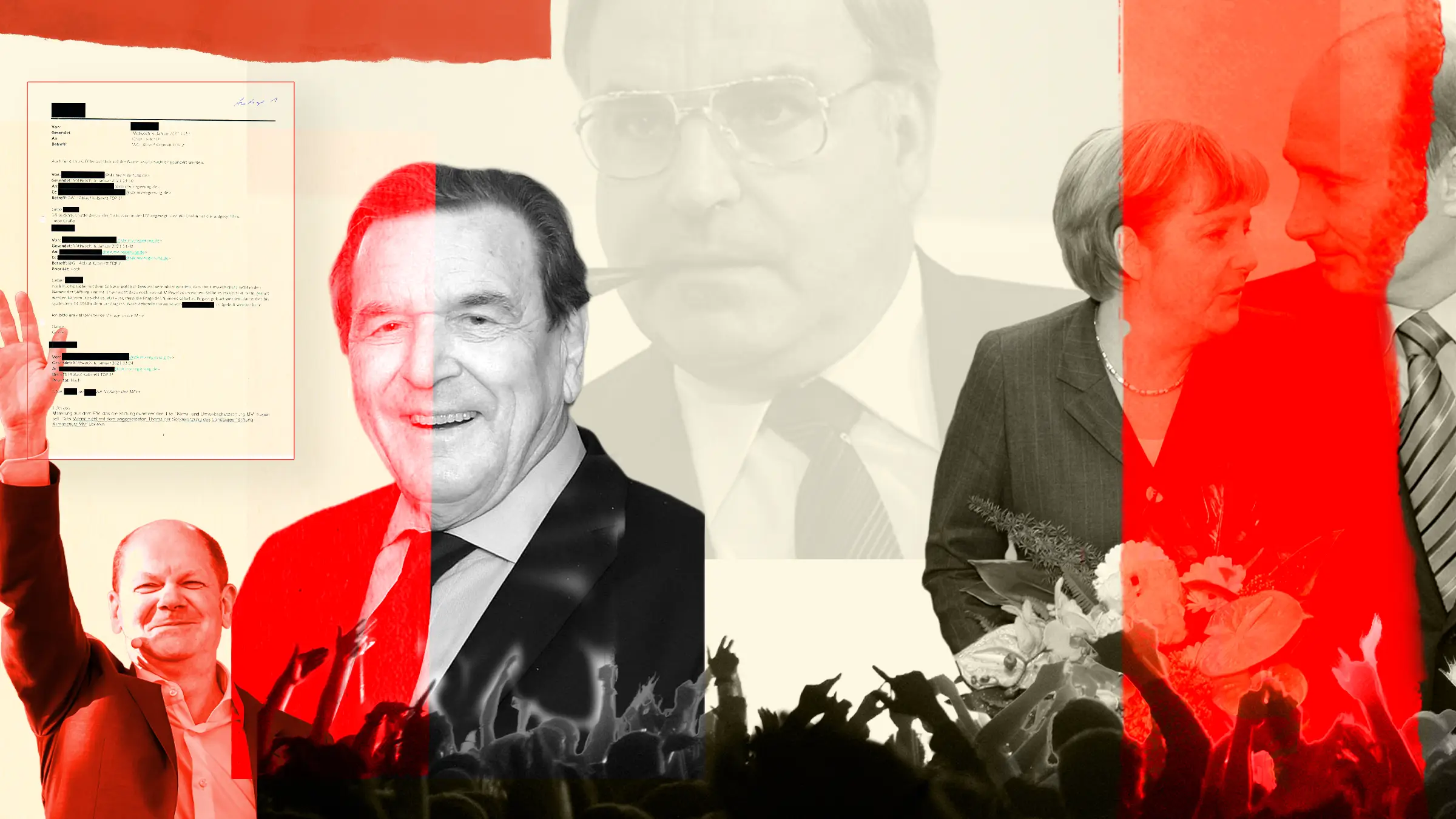
Illustration: © Sabine Mescher
Dossiers: European Union · Germany · Narrative Warfare · NATO · Russia
Zeitenende: Germany's People's Parties
The study is available in German only. English-language readers are welcome to contact us for support.
In the local branches of the SPD and the CDU the chairs have emptied, while in Berlin the two parties still run the ministries. Turnout is back where it stood in 1998. The centre is not: the two parties then won 61.7 per cent of all eligible voters, in 2025 36.9, in the east 23.6. DURCHD8’s study calls it Zeitenende, the end of an era. It shows who cleared the space, and who moved into it.
Companion Documents
Essay — A readable analytical article framing the subject, context, and significance.
Briefing — The decision-maker’s version: key findings, implications, and operational relevance.
Assessment — A concentrated analytical diagnosis for readers who need the argument.
Architectural Analysis — The complete scientific analysis.
Current State
As of 18 October 2026. The first test after the study came in Magdeburg. On 6 October the new Landtag of Saxony-Anhalt elected the AfD's Tobias Rausch as its president by 48 votes to 29, and the next day the SPD ended its talks on a government without the AfD. The CDU, down to 17.2 per cent, had already set its course for opposition. The AfD's lead candidate Ulrich Siegmund intends to stand for minister-president in December, three votes short of a majority. In Schwerin a majority without the AfD now rests on Die Linke, and in Berlin Die Linke came first with 25.7 per cent.
At the federal level ten per cent of voters told ARD's DeutschlandTrend for October that they were satisfied with the government, a record low. Every institute puts the AfD first nationally, at 26 to 30 per cent, with the CDU/CSU at 18 to 23. The finding holds wherever it can be tested so far. The next test is the vote for minister-president in Magdeburg in December.
Mechanism
Both people’s parties cleared a flank of their own following, and each move won elections in its day. Under Gerhard Schröder the SPD moved to the centre with the Agenda 2010, and the left it gave up filled with the WASG, Die Linke and later the BSW. Under Angela Merkel the CDU/CSU took over social democratic positions, from the minimum wage to the exit from nuclear power, and gave up the right. Her word for the euro rescue, alternativlos, became the non-word of 2010. It suggested, the jury wrote, that a decision needed no argument, and the argument moved to the edge. Economists founded the AfD over the euro in 2013. In 2015 it grew on migration.
Cheap money and reliable energy covered the loss for two decades. In 2022 real wages fell more sharply than in any year since 1950, and the cover was gone. The study treats that shock as context. The cause lies in the cleared flanks. Government kept working and so did the economy. What tore was the binding, the sense of being represented. About 61 per cent of the AfD’s new voters of 2025 came from the CDU/CSU, the SPD and the FDP, a panel survey found. The voters left from the centre.
At Stake
In four eastern states the AfD alone holds more than a third of the seats. Every change to a state constitution and every election of a constitutional judge there needs its votes. In the Bundestag the AfD and Die Linke hold 216 of 630 seats, so each change to the Basic Law needs one of them. The bloc reaches beyond Germany. Its weight bears on Germany's seat in the EU Council, where sanctions need unanimity, and on NATO's eastern flank, whose reinforcement runs across Germany.
The study names one condition under which the space would close: an offer that answers the questions of representation and holds over years. In the east, where the chairs were never full, it would bind voters for the first time. Which party in Berlin can still make an offer that lasts that long?
Political Relations
The SPD and the CDU/CSU govern together in Berlin under Friedrich Merz. They opened the two spaces and still hold the oldest voters: in 2025 a third of the SPD’s voters and almost a third of the Union’s were 70 or older. The AfD, Die Linke and the BSW fill the spaces and form no alliance. The AfD holds the right flank alone. The left is split between Die Linke and the BSW, which lost ground in all three September elections and on 1 October dropped its founder’s name. The study counts all three as opponents of the Federal Republic’s foundations, from its ties to the West and NATO to representative democracy, each to a different extent: the AfD most broadly, the BSW along the line of NATO and sanctions, Die Linke least. In Magdeburg and Schwerin the centre reaches a majority without the AfD only with votes from the same bloc. Russia works from outside. Campaigns that researchers attribute to Russian operations targeted politicians of the CDU, SPD, Greens, Linke and FDP before the 2026 elections and spared the AfD and the BSW. The Greens are the counter-example: their membership rose from about 48,000 in 2009 to 155,000 in 2024 on an offer that binds a young cohort.
Research
DURCHD8 published the case on 8 October 2026 in four German texts. The flagship Zeitenende: Macht ohne Bedeutung ist bedeutungslos runs to 198 pages. It follows the chancellors from Helmut Kohl to Friedrich Merz, the three parties that grew into the vacated flanks, and the east since 1990. It tests six common explanations, from the business cycle to foreign disinformation, grades every central finding by confidence and states what would refute it.
The study bound itself in advance. Its signed version of 20 August expected a bloc above half the vote in every eastern state. Saxony-Anhalt confirmed it in September with 57.6 per cent, Mecklenburg-Western Pomerania refuted it with 49.6, and the published study records both. Zeitenende: eine Mitte, die sich leert tells the finding to the general reader, Zeitenende: Briefing zur Repräsentationslücke sets out the misreadings for those who decide, and Zeitenende: Lagebewertung der Repräsentations-Erosion condenses the mechanism for analysts. All four are archived on Zenodo under a Creative Commons licence, and DURCHD8 supports readers who need them in English.
Every figure comes from public series of elections, memberships and surveys and can be checked at its source.