Illustration: © Sabine Mescher
Academia · Civil & NGOs · Corporate · Institutions · Intergov · Media · Non-State · States
NATO
Aboard Air Force One on 8 July 2026, flying home from the summit in Ankara, the American president was asked whether more troops would leave Europe. “Maybe,” he said. A lot would depend on Greenland. The summit had produced a declaration of six paragraphs. DURCHD8’s NATO study explains how the alliance can be at its strongest and still not decide: routines hold thirty-two states together, and the decisions of a fast crisis fall to whoever can act alone.

Current State
As of 18 October 2026. The strikes now reach the alliance's shores and housing blocks, and the answers stay national. Overnight into 13 October drones sank a merchant ship off the Bulgarian village of Krapets and struck a second off Byala. Eleven sailors are missing, and the search ended on 14 October. That night two more ships caught fire off Romania. Sofia informed its allies, asked for air and maritime surveillance and summoned Russia's ambassador. In May a drone had hit a block of flats in Galați, and Bucharest answered in the same way, with national steps and requests for help.
The money keeps rising. At The Hague the allies committed to 5 per cent of GDP by 2035, 3.5 of it for core defence, and NATO expects five members to pass that mark this year. The American presence moves the other way. About 5,000 troops are to leave Germany, and a Pentagon review owes the defence secretary options for all US forces in Europe by 6 November. That date is the next marker of how much of the alliance Washington still means to carry.
Mechanism
The alliance runs on routines that need no fresh decision. More than 1,200 common standards let the forces of thirty-two states work together, a four-year cycle hands each member its targets, and officers pass through the same schools in Rome and Oberammergau. When Viktor Orbán’s government drifted from the alliance, Hungary’s army went on applying the standards. The council almost never refuses. DURCHD8’s study estimates 12,750 to 21,250 consensus decisions from 2022 to April 2026 and documents sixteen cases of dissent, opt-out or blockade.
Above the routines sits an order the members seldom name. Every supreme commander in Europe since Eisenhower in 1951 has been American, the nuclear guarantee rests with the American president, and the F-35 ties air forces to American software. Warsaw and the Baltic capitals read Russia as a threat of this decade, and Poland puts 4.7 per cent of its output into core defence. Western capitals read a contest of decades, and Spain spends 2 per cent. Washington reads Europe through its rivalry with China. The machine keeps time in four-year cycles. A crisis on the flank runs in days, and then the decision passes to whoever can act alone.
At Stake
The promise is tested where the map is narrowest. In Münster a corps headquarters of sixteen nations prepares to command 50,000 soldiers in the defence of Estonia and Latvia, and its use rests on a decision of all thirty-two governments. The Europeans pay more each year and take over commands, while the size of the American presence is settled in Washington. The attacker chooses the hour. For the soldiers on the flank and the towns behind them, the alliance is worth what it can decide together, in time.
When the next strike on the flank moves faster than the council, which capital will act first, and will the others follow it as an alliance?
Political Relations
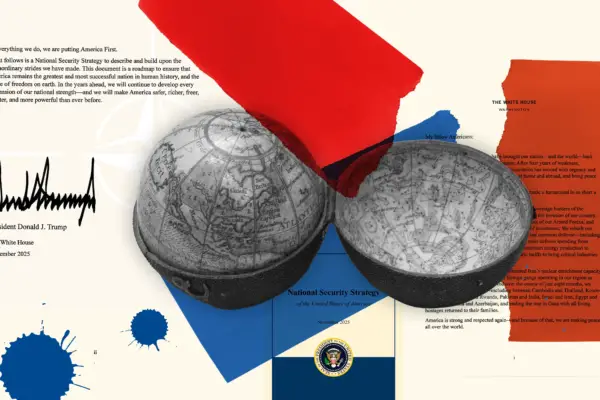
Weight in the alliance is still American. By NATO’s estimate the United States spends 1,033 billion dollars on core defence in 2026, the European allies and Canada together 777 billion. Americans keep the air, land and maritime commands, while European officers take over the three joint force commands in Brunssum, Naples and Norfolk. Washington’s security strategy of December 2025 ranks Europe third among its regions, after the Western Hemisphere and the Indo-Pacific, and its defence strategy of January 2026 sorts partners into “Model Allies” and “Dependencies”.
Among the Europeans, Germany has the largest budget, Britain and France hold the continent’s own nuclear deterrents, and the Nordic and Baltic states form the densest web of cooperation. The EU has become a second channel: its SAFE loans of 150 billion euros pass by qualified majority, outside the unanimity that binds NATO’s council. Russia is the threat both recent summit declarations name. Ukraine, outside the alliance, now draws most of its security assistance from European allies and Canada.
Research
DURCHD8 sealed its NATO study on 14 April 2026 under a cryptographic timestamp and named in advance what would refute each finding. NATO Consensus as Ceremony reads the alliance as it stood on 8 April through some seventy theories of the social sciences, from Weber on bureaucracy to Tilly on war and the state. The weeks that followed became its test. A ceasefire between Washington and Tehran, an American troop cut and a truce in Ukraine were all settled outside the council, and none of the named refutations occurred. Its current version is deposited at Zenodo. NATO’s Coordination Architecture Under Stress gives the argument in short, NATO’s Hidden Failure Mode the briefing, and Brussels, Spring 2026: An Alliance Functioning Without Deciding the plain account.
The later studies follow the money. The Readiness Gap Is Structural finds that spending turns into deployable forces more slowly than it rises, and European Defence Autonomy: A Capable Answer, Wrong Layer tests a plan to defend Europe with less America. Reclassified: Europe’s New Position in the 2025 U.S. National Security Strategy reads the American turn behind both.
Zeitenende: Macht ohne Bedeutung ist bedeutungslos ends on a question it leaves open: what Warsaw, Vilnius and Washington read from the AfD, among whose supporters 48.2 per cent rejected arms deliveries, against 18.6 per cent nationwide.
The NATO study also left a test for the months ahead. If deterrence works, the probing of the flank should grow rarer.