
Illustration: © Sabine Mescher
Academia · Civil & NGOs · Corporate · Institutions · Intergov · Media · Non-State · States
Across dossiers: Narrative Warfare
Narrative Warfare Foundation
On 7 December 2025 DURCHD8 published a text of six minutes’ reading that opens with a man, a woman and a child. The father goes out to hunt. If he fails, hunger arrives. In thirteen scenes it moves on to the king, the state, Churchill, Hitler, Adenauer and Bin Laden. In each, a role draws its resources from the meaning others find in it. Lose the meaning, the last scene says, and the power goes with it. A riddle published the same day asks what kind of text this is.
Companion Documents
Essay — A readable analytical article framing the subject, context, and significance.
Briefing — The decision-maker’s version: key findings, implications, and operational relevance.
Assessment — A concentrated analytical diagnosis for readers who need the argument.
Architectural Analysis — The complete scientific analysis.
Current State
As of 18 October 2026. The text stands as it was published, and its claim now carries a study of 198 pages. Zeitenende, published in German on 8 October, puts it in its title: Macht ohne Bedeutung ist bedeutungslos, power without meaning is meaningless. The study tests the claim on Germany's party system from 1990 to 2026.
The formal side has grown as well. The preprint on durable coordinated power, in its version of 24 August 2026, starts from three conditions: at least two actors, dependence between them, and the reading of signals. From these it derives that actors in different positions can read the same signal differently, and that coordination is never guaranteed. The circle the text describes can therefore break at any turn. Four other case studies have put the reading to work, on the way Russia governs information, on the dissent of a retired Russian general, on NATO and on hybrid warfare in Europe.
Mechanism
The text builds its argument from roles. The best hunter leads the hunt because he brings food. The elders speak when danger rises because they remember what once was. Experience, knowledge and judgement turn into resources once others rely on them. In the state the same logic gives an office the right to act in the name of all.
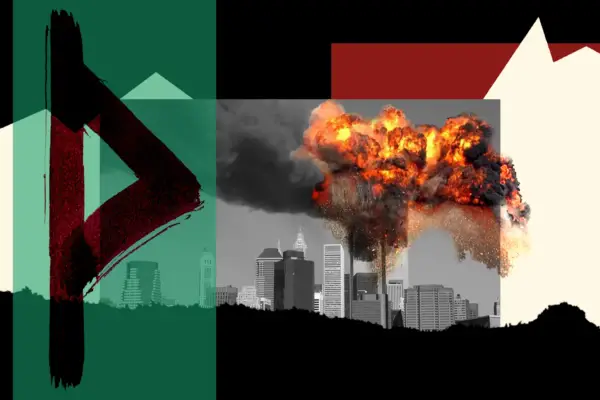
Hitler crafted an image in which many saw themselves and took the state with its police, its administration and its army. Adenauer, after the collapse, gathered trust through reliability and used it to steady the institutions of a young republic. Bin Laden struck a symbol of American height and safety. For the United States the shock broke an image of invulnerability, and in others it made him mean something: he drew attention, recruits, money and allegiance from it.
The circle also runs backwards: meaning lost becomes legitimacy lost, then resources lost, then power lost. Since devices put billions in touch within seconds, the text argues, legitimacy has moved from office to attention. Where expectations grow faster than institutions can answer, a vacuum opens, and stories fill it with orientation, belonging and an enemy.
At Stake
If power goes with meaning, the loss begins long before an office is vacated or a budget cut, at the point where the people a role depends on stop seeing what it is for. Majorities hold on paper while that happens, and alliances keep their command structures.
The riddle adds a second stake for anyone who answers such a text. Its fourth observation holds that criticism has to use the very mechanisms the text exposes. A rebuttal, a correction or a counter-story works through meaning too, and so it feeds the contest it means to end.
What could a government measure that shows its meaning thinning before an election shows it?
Political Relations
Every scene of the text runs on the same exchange. The many grant, the one receives. A clan follows the hunter who feeds it, and a community hands its war leader its lives. People pool harvest, labour, roads and weapons for a king and give him insignia so that all can see who guards order. In the state the grant becomes an office that holds resources beyond any single life.
Today the text sees two relations under strain. Governments face publics whose verdict, it says, has become a resource that governments feel, moving from screen to screen faster than reason. And a single actor without a state can shake a world power, as Bin Laden did by bringing down an image. In the text’s words, conflict is now decided by images, words and the speed of their spread, alongside weapons.
Research
Two pieces of 7 December 2025 make up the case. Humans: Narrative Warfare, Plain and Precise is the text itself, thirteen scenes without a footnote. A riddle published the same day treats it as an object of study. It lists five effects, among them that meaning is installed before contestation begins and that the effect persists once the wording is forgotten. Then it sets a task: among forty-six concepts, find the five the text never names, and ask why a text would need them unnamed.
The formal side sits in the preprint Narrative Power: How Does Durable Coordinated Power Emerge?, which derives from minimal conditions what the scenes show, and Zeitenende: Macht ohne Bedeutung ist bedeutungslos tests the claim on a party system.
The riddle’s task stays open to every reader, with the text and the list of concepts as the only material it needs.