
Illustration: © Sabine Mescher
Academia · Civil & NGOs · Corporate · Institutions · Intergov · Media · Non-State · States
Institutions
Europe's institutes in 2026: their verdicts travel under the house's name, and a second reading sits in its own files.
On 2 September 2025 Russia’s Prosecutor General declared London’s Royal United Services Institute undesirable. Its seminars, the statement said, discussed Russia’s ways of waging war “under the guise of countering a supposed Russian threat”. London reads the same work as research. Ministries there and in Berlin pay for much of it. DURCHD8 tested verdicts from four institutes, RUSI, SWP, ECFR and EDINA, and each time found a second reading in the house’s own material.



Current State
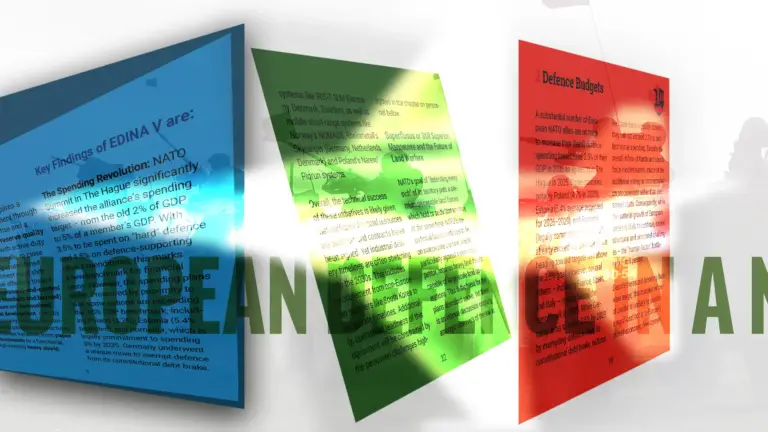
As of 18 October 2026. Three of the four institutes spent the year on one question, how far Europe can still count on the United States, and Washington has since given part of the answer. In January an SWP study judged that the United States was moving towards competitive authoritarianism, and SWP's leaders wrote that the era of American protection was coming to an end. In April EDINA's director and its head of research wrote that from 2027 the United States would supply only half of the alliance's combat power. In June ECFR proposed a European way of defence and published a poll of 19,481 people in 15 countries, in which 11 per cent still counted the United States as an ally. On 22 May Washington had told its allies it would cut its share of NATO's force model.
The fourth question was Russia's. A RUSI commentary had named 2026 the year of hybrid escalation. Three quarters of that year have passed, and officials describe the pressure as rising, from the director of GCHQ in May to NATO's deputy secretary general on 31 August. The next marker is 6 November, when the Pentagon owes its defence secretary options for American forces in Europe.
Mechanism
An institute’s weight rests on its name, and some names are old. RUSI was founded under the Duke of Wellington in 1831 and has held a royal charter since 1860. The Bundestag voted to fund SWP in 1965. ECFR has gathered a council of more than 330 Europeans since 2007, serving foreign ministers among them, and EDINA sends one questionnaire to experts across the continent. Ministries, editors and donors see in each name expertise held at a distance from power, and on the strength of it the houses reach officials, win contracts and make front pages.
Each house writes with many hands. RUSI states that it has no corporate view, ECFR that it takes no collective positions, SWP that its studies give the view of their authors. The name travels with every paper all the same. The money sits close to the state. The federal budget pays all of SWP’s core work, RUSI receives support from the British and American governments and the European Commission, and ECFR’s donors include France’s armed forces ministry and the Dutch defence ministry. What London funds as research, Moscow’s prosecutors called anti-Russian propaganda.
At Stake
Ministries carry these verdicts into budgets and plans. Germany's defence budget for 2027 and the next payments from the EU's defence funds were drawn up while the papers of the four houses circulated. RUSI's forecast dated a danger to one year, SWP's study judged an ally without a stated test, and ECFR's plan rested on a premise its own diagnosis argued against. Each arrived with the standing of the house that printed it. The material for a second reading sat in the same archive, under the same name, open to anyone who looked.
When a verdict reaches a ministry under a trusted name, who there reads the pages that speak against it?
Political Relations
RUSI, SWP, ECFR and EDINA have dossiers of their own, and four cases test their work: RUSI’s forecast of hybrid escalation, SWP’s verdict on American democracy, ECFR’s plan for European defence and the readiness gap EDINA measured. Each stands close to governments in its own way. SWP’s grant is a line in the federal budget, governments and the Commission fund RUSI’s work, serving ministers sit on ECFR’s council, and EDINA’s director also advises the European Policy Centre.
The houses feed one another. EDINA’s report draws on contributors from RUSI and from institutes in Athens, Helsinki and Stockholm, and DURCHD8 wrote a companion study to a roadmap by EDINA’s Christian Mölling and Torben Schütz for the European Policy Centre. Moscow counts such houses among its adversaries. It declared the German Council on Foreign Relations undesirable in March 2025 and RUSI in September, and SWP stated that it stood unshakably at the German council’s side.
Research
Each DURCHD8 test takes one text and the house’s own published record. It quotes the text, reads it first on its own premises, and then asks whether the house’s evidence carries the house’s verdict. Three days after the RUSI commentary of 19 December 2025, Hybrid Warfare Is Already Working set its forecast against RUSI’s earlier work, which counted more than 200 incidents from 2014 to 2024, and found a campaign under way for years. A day after SWP’s study on Trump, Einordnung der SWP-Studie „Systemsprenger” found the study’s own page 27 recording lower courts that rule against the administration in most cases. From Capability Substitution to Decision Control took up the roadmap by Mölling and Schütz and asked whether Europe can still decide under time pressure.
Two longer studies followed in 2026. The Readiness Gap Is Structural sets EDINA’s survey beside DURCHD8’s NATO study and finds the two agreeing on the evidence and parting on whether reform can close the gap. European Defence Autonomy: A Capable Answer, Wrong Layer finds in ECFR’s plan a sound diagnosis joined to a remedy built one level down.
What the tests can show is narrow and checkable: whether a verdict agrees with what its own house has published.
Featured Disclosures
Essay — A readable analytical article framing the subject, context, and significance.
Briefing — The decision-maker’s version: key findings, implications, and operational relevance.
Assessment — A concentrated analytical diagnosis for readers who need the argument.
Architectural Analysis — The complete scientific analysis.