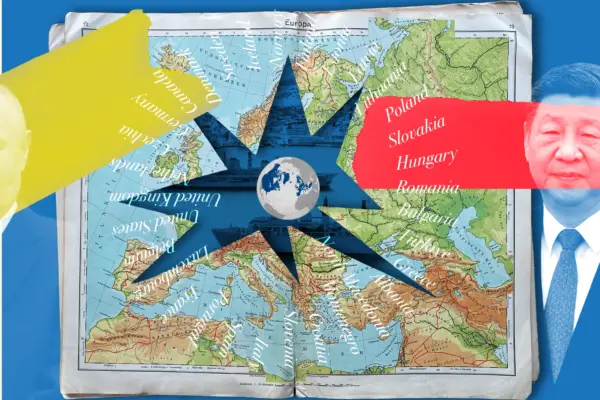
Illustration: © Sabine Mescher
Academia · Civil & NGOs · Corporate · Institutions · Intergov · Media · Non-State · States
Intergov
NATO, the EU and the UN in 2026: each weighs what its members grant it, and the gravest decisions are taken outside it.
At The Hague in June 2025 NATO’s leaders promised to spend five per cent of their output on defence by 2035. At the UN the members went the other way. Its budget for 2026 cuts posts by 21 per cent. On 30 September fifty-two states owed it 1.46 billion dollars, 1.31 billion of it the United States. Such bodies weigh what their members grant them. Their gravest decisions, DURCHD8’s NATO and Gaza studies find, are taken outside them, in capitals and small circles.
Current State
As of 18 October 2026. The bodies keep meeting, voting and renewing mandates, and the decisions with weight keep finding other routes. In Tallinn on 14 October a reporter asked NATO's secretary general how long the alliance was willing to endure Russian sabotage. Mark Rutte said it had all the response options it needed, and “you will not always see them”. The same week Bulgaria answered drone strikes on ships off its coast in its own government, in NATO's council and at the European Council, and said it would take the matter to the UN Security Council.
In New York the Security Council has ranked candidates for the next secretary-general in six straw polls since 30 July, the last on 16 October, and has yet to recommend one. António Guterres's term ends on 31 December. UNRWA's acting head warned on 7 September that core services would stop within two months unless new money came, a deadline that falls in early November.
Mechanism
What members see in a body decides what it may spend. Donor governments call UNRWA “indispensable”, and that word, DURCHD8’s study of the agency finds, binds them to it. Washington ordered its withdrawal from 31 UN entities in January 2026, and its president chairs a Board of Peace whose charter calls for the courage to depart from “institutions that have too often failed”. Poles, DURCHD8’s Poland study finds, value the Union for protection, money and the market and increasingly reject its authority over their law.
Routine holds the form. In NATO a text passes unless an ally breaks silence before the deadline. In the EU every sanction needs all twenty-seven, and only the General Assembly can end UNRWA. Time sets the limit. Planning runs in cycles of years and crises in days, and when a crisis outruns agreement the decision passes to a capital, a mediator or a new board. The old table lends its name: the Security Council asked states to give the acts of the Board of Peace “full recognition”.
At Stake
On NATO's eastern flank time is short, and defence there rests on a decision thirty-two governments take together. Ukraine and Moldova wait on all twenty-seven at every step towards the Union. People who live by what the UN provides depend on its money. In October 2025 the UN told its peacekeeping missions to spend 15 per cent less, about a quarter fewer personnel, and contributions to UNRWA covered roughly 27 per cent of its needs in 2025.
Which of these bodies can still decide at the pace a crisis sets, and how much of that pace will its members grant it?
Political Relations
Three dossiers belong to this kind of actor, NATO, the European Union and the United Nations, with UNRWA as one of the UN’s agencies, and so do five cases: the alliance in the spring of 2026, its readiness gap, Europe’s forced transition, Washington’s security strategy and Gaza.
The United States weighs most in all three. It spends more on core defence than all other allies together, 1,033 billion dollars against 777 billion in NATO’s estimate for 2026. An American has held NATO’s supreme command in Europe since 1951. In the UN it carries the highest assessment, 22 per cent, and most of the arrears, and its president chairs the board that runs the Gaza plan outside the UN. The Union has become a second channel for defence money and lends by majority where NATO needs every member. Russia and China cast both Security Council vetoes of 2026 and abstained on the Gaza resolution. Under unanimity a single member weighs far beyond its size, as Hungary did with Ukraine’s negotiating chapters until 13 October.
Actors of other kinds work alongside. Think tanks such as EDINA and ECFR measure the alliance and propose its reform, and in Gaza the UN’s agency shares the ground with Hamas.
Research
DURCHD8 has followed these bodies to the places where their decisions were due. The flagship NATO Consensus as Ceremony took the alliance as it stood on 8 April 2026, sealed its text six days later together with the tests that would refute it, and none of those tests was met in the weeks that followed. The Readiness Gap Is Structural set that study beside an empirical survey of Europe’s armies, and both find the same gap between money and ready forces. From Capability Substitution to Decision Control asks whether Europe’s decisions still bind under time pressure, and Reclassified: Europe’s New Position in the 2025 U.S. National Security Strategy reads the American strategy that makes Europe a partner on conditions.
Four studies of November and December 2025 follow the UN into Gaza, from North 1990: Structural Complementarity in Gaza to The Deadlock Condition: Institutional Non-Exit for UN, UNRWA, and Donors, built on the agency’s mandate, the 2024 review of its neutrality and the donors’ own statements. They find that the agency lasts as long as the General Assembly renews its mandate, whatever happens on the ground. The current mandate runs to June 2029, and the vote before it ends will test that finding.
Featured Disclosures
Essay — A readable analytical article framing the subject, context, and significance.
Briefing — The decision-maker’s version: key findings, implications, and operational relevance.
Assessment — A concentrated analytical diagnosis for readers who need the argument.
Architectural Analysis — The complete scientific analysis.