
Illustration: © Sabine Mescher
Academia · Civil & NGOs · Corporate · Institutions · Intergov · Media · Non-State · States
Across dossiers: European Union · NATO · United States
NSS 2025:
Europe Reclassified
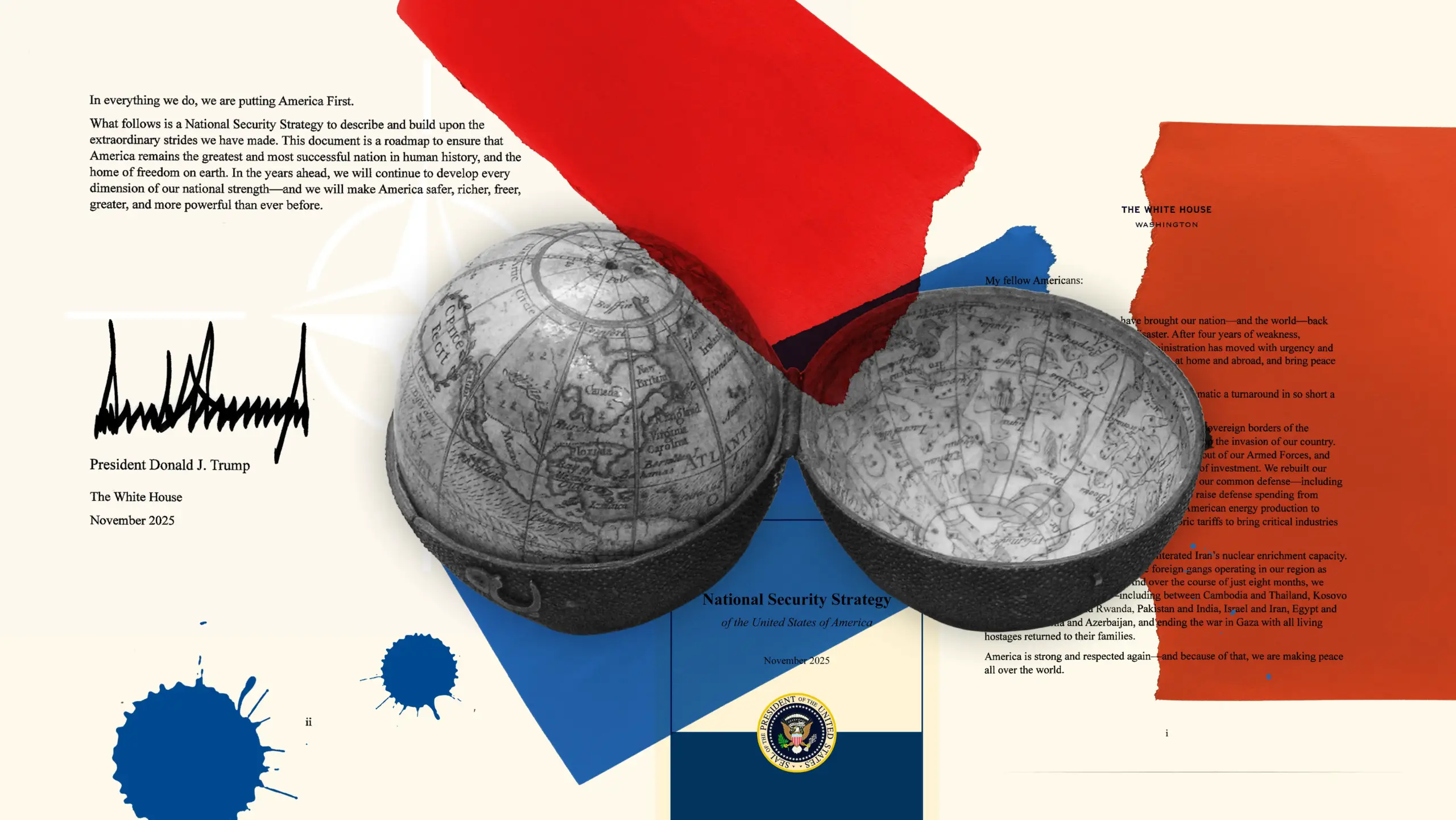
Late on 4 December 2025 the White House put a 33-page security strategy online. Its regions run from the Western Hemisphere to Asia and only then to Europe, which it saw facing “civilizational erasure”. Asia got 25 paragraphs, Europe 13. DURCHD8’s reading, published six days later, finds a strategy that weighs every commitment in Europe against the contest with China and grants partnership on conditions.
Companion Documents
Essay — A readable analytical article framing the subject, context, and significance.
Briefing — The decision-maker’s version: key findings, implications, and operational relevance.
Assessment — A concentrated analytical diagnosis for readers who need the argument.
Architectural Analysis — The complete scientific analysis.
Current State
As of 18 October 2026. Ten months on, the strategy has become force planning, and the reading of December holds. On 1 May the Pentagon announced that about 5,000 of the 36,000 American troops in Germany would leave. On 18 June Defence Secretary Pete Hegseth announced a review of American forces in Europe and told allies that their defence budgets had “cratered, along with Europe's belief in itself and its civilization”. The strategy's language had reached the Pentagon. A questionnaire for the review asks each ally whether it has publicly opposed regulations “designed to inhibit or reduce transatlantic defense industrial cooperation”, and if not, whether it would.
The strategy's hope in “patriotic European parties” met a test in Hungary. Vice President JD Vance campaigned for Viktor Orbán in Budapest on 7 April. Five days later Orbán lost by a landslide. The review's options are due on 6 November and will show how the conditions are applied, ally by ally.
Mechanism
The strategy changes the yardstick. Partnership with Europe used to be measured by how far its institutions grew together. This text measures birth rates, migration and what it calls censorship, and it counts the European Union among the bodies whose activities “undermine political liberty and sovereignty”. In DURCHD8’s reading Europe now plays three roles at once: a partner where capabilities align, a vulnerability where its divisions tie down American resources, and a space of influence where Washington sides with some parties against others. The strategy calls them its “political allies in Europe”. Asia sets the price of all three.
The Kremlin’s spokesman found the changes “largely consistent with our vision”. France’s minister delegate for the armed forces called the text “an extremely brutal clarification” and asked for faster rearmament. In Budapest the open American backing for Orbán mobilised the other side, as DURCHD8’s NATO study finds, and his opponents won with the highest turnout since 1990.
A strain runs beneath it that feeds on itself. Each year Europe stays below its pledges makes the next American commitment harder to defend in Washington, and each swing in American politics makes Europe doubt the one it has. The strategy, the study concludes, ends the illusion that the transatlantic chapter writes itself.
At Stake
For the governments that host American forces, the guarantee their defence has rested on now comes with a review and a pass mark. Some will fail, Hegseth said. For the European Union its own rules turn into a test: SAFE lends 150 billion euros for arms by majority vote and limits procurement from outside the Union to 35 per cent, while the Pentagon's questionnaire asks the same governments how they stand on rules that hold back transatlantic defence business. Ukraine draws most of its military aid from Europe and Canada. The talks about its future run through Washington's envoys.
Which of Europe's governments can meet Washington's conditions and the Union's rules at the same time?
Political Relations
The levers the strategy names sit in Washington. The Pentagon decides where the roughly 80,000 American troops in Europe stay, and Hegseth and his policy chief Elbridge Colby run the review. NATO’s American commander, General Alexus Grynkewich, called the old force plans “an unhealthy co-dependence” on American forces. Europe’s levers are its money and its own rules, and Secretary General Mark Rutte said in June that other allies would fill “a lot” of the gaps the United States leaves.
The addressees answer from different places. Germany’s defence minister called the troop cut “foreseeable”. France asked for faster rearmament, and Hungary changed course at the ballot box. The parties the strategy hopes for sit in the European Parliament as Patriots for Europe, its third-largest group. Russia stands outside the review and inside the text. The strategy wants to “reestablish” strategic stability with Moscow, records that many Europeans regard Russia as an existential threat and gives Washington the task of managing “European relations with Russia”.
Research
Reclassified: Europe’s New Position in the 2025 U.S. National Security Strategy appeared on 10 December 2025, six days after the strategy. It reads the document on three levels: its own words, the indicators of capability and cohesion on both sides of the Atlantic, and the dynamics the two create for Europe. It counts the space the text gives each region and names what it calls the Atlas break, after the strategy’s sentence that the days of America “propping up the entire world order like Atlas are over”. Then it sketches six paths for Europe and, on the evidence of 2024 and 2025, rates two as most plausible: fragmentation that persists, and sovereignty language without the money behind it.
On money the record has since moved against the second. European allies and Canada raised core defence spending by more than 19 per cent in 2025, NATO reports. The Readiness Gap Is Structural finds that more spending alone does not close the distance to deployable forces. Written a week after the first study, From Capability Substitution to Decision Control asked what such a forced transition does to Europe’s ability to decide, and in May 2026 NATO Consensus as Ceremony read the strategy as the declared doctrine behind the American moves of that spring.
The six paths remain a scale on which each year’s spending figures and the review’s decisions can be laid.