
Illustration: © Sabine Mescher
Academia · Civil & NGOs · Corporate · Institutions · Intergov · Media · Non-State · States
EDINA
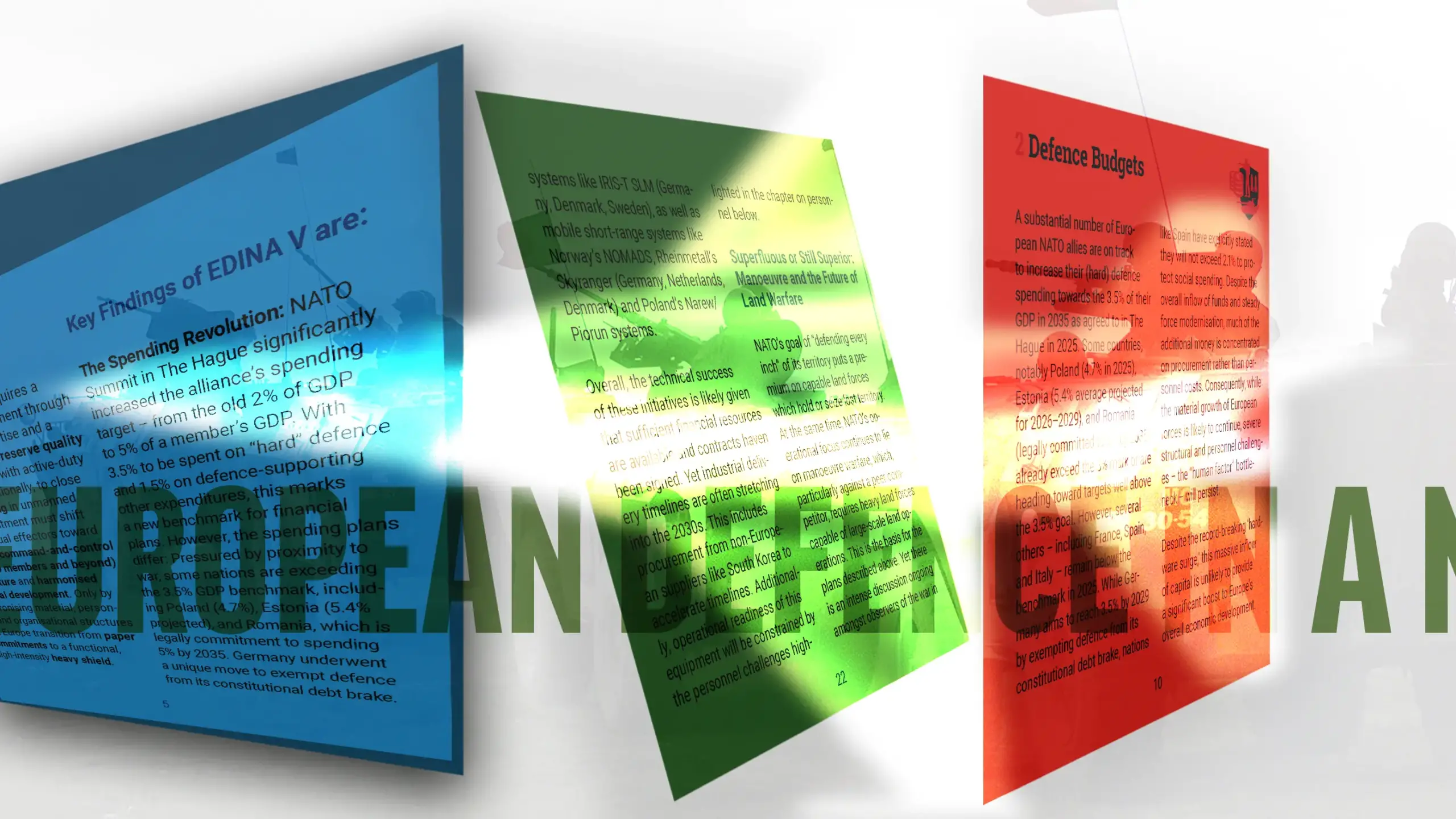
Researchers in eighteen NATO countries and in Serbia, at institutes such as Elcano in Madrid and ICDS in Tallinn, answered one questionnaire about their armed forces. In February 2026 EDINA, a think tank directed by Christian Mölling, compiled the answers into its fifth report and put the verdict into the subtitle: Why Money Alone Won’t Deliver Capability. One line carries the rest. The soldiers of the next two decades are already born. DURCHD8 shares the evidence and reads it differently.

Current State
As of 18 October 2026. The surge EDINA caught at its start has kept going, and its authors have since turned to what Europe does if American help comes late. EDINA V recorded Poland at 4.7 per cent of output for defence in 2025, Germany freeing defence from its debt brake, the return of heavy armour and a personnel crisis reported by almost every country. NATO's estimates of July confirm the direction: Germany spends 2.69 per cent of its output on core defence in 2026, on a path towards 3.5 per cent by 2029.
In April, writing for the European Policy Centre, Mölling and Torben Schütz, who leads EDINA's research, argued that from 2027 the United States would provide only half of the alliance's combat power, and that Europe was barely insuring itself against American support being “limited, delayed or politically blocked”. The real gap, they wrote, lies in political and military leadership. EDINA's latest publication on its own site is a short profile of Europe's armoured-vehicle industry from April 2026.
Mechanism
EDINA works by asking. The same structured questionnaire goes to country experts, many at national institutes, and their answers are compiled into one comparative report, edition after edition since 2022. The method sees what governments plan, budget and report, from land forces to personnel and drones. Its figures stand as the contributors give them, and DURCHD8’s comparison notes that the survey carries no sources for its country numbers and follows the framing of a report that tracks policy.
On page 5 of EDINA’s report, synchronising material, people and organisation turns paper commitments into “a functional, high-intensity heavy shield”. On page 28, growing the forces and raising their readiness at the same time is called “impossible”. Read as a reform programme, the evidence points to better allocation, joint command, recruitment informed by labour-market experts and reserves trained to the standard of active forces. Read against how the alliance is built, the shrinking cohorts and the slow turning of money into units place the source of the gap below the reach of such measures.
At Stake
EDINA's numbers travel into ministries. Its recommendations are written for Germany and Europe at the moment budgets are set for a decade, and Berlin, for one, plans to raise core defence spending towards 3.5 per cent of output by 2029. A budget built on the reform reading buys allocation, command and recruitment, and its spending line will report progress. If the structural reading holds, the floor of people and the slow conversion of money will bind for a decade whatever the programme achieves, and the metric meant to track progress will hide its absence.
Which reading will the budget rounds in Berlin and the other capitals take from EDINA's evidence: a gap within reach of reform, or a condition to be managed for a decade?
Political Relations
EDINA places itself between analysis and practice, and its people link it to the wider field. Its director is also a senior adviser at the European Policy Centre, which published his call with Schütz for a European plan B for NATO. Its country experts come from ELIAMEP in Athens, the Finnish Institute of International Affairs, the Swedish Defence Research Agency, the Royal United Services Institute in London and the German Marshall Fund, among others. The site’s imprint gives a business address, Defcom One in Mülheim-Kärlich, which also publishes the reports.
EDINA measures against NATO’s yardsticks. Its fifth report follows the move from the old target of 2 per cent of GDP to the 5 per cent agreed at The Hague, and the way NATO’s minimum capability requirements turned national plans from modernisation to growth. Its first audience is Berlin: in its own words EDINA turns defence policy into recommendations “for Germany and Europe”.
Research
In DURCHD8’s work EDINA appears as the second witness of the readiness gap. The Readiness Gap Is Structural compares EDINA V point by point with NATO Consensus as Ceremony. The two agree on the gap between money and deployable force, on the cohorts already born and, almost word for word, on Europe’s split over drones, where politics wants drones to show strength and soldiers want protection against them. They part on whether spending and reform can close the gap. The comparison calls EDINA’s programme the present ceiling of the reform approach and places the limit in the structure of the alliance, a judgement about reach that leaves the authors’ merit untouched. Readiness Gap Briefing: Euros vs. Deployable Force and The Surge and the Shortfall carry the result to decision-makers and to the general reader. In December 2025 From Capability Substitution to Decision Control had already answered the roadmap Schütz and Mölling wrote for the European Policy Centre.
Both readings can be checked against the same public series: NATO’s yearly spending estimates and the armies’ own personnel counts.