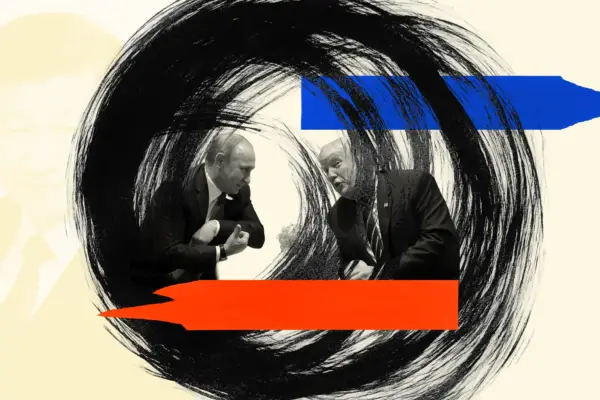
Illustration: © Sabine Mescher
Academia · Civil & NGOs · Corporate · Institutions · Intergov · Media · Non-State · States
RUSI
At 61 Whitehall, on the same street as the Ministry of Defence, works the institute the Duke of Wellington founded in 1831. It has been there since 1895. Under each commentary it prints a line: the views are the authors’, and they do not represent RUSI. In the year to March 2026 its experts appeared in more than 30,000 news articles. DURCHD8 tested one RUSI forecast against the rest of that archive and found the evidence against it in RUSI’s own pages.
Current State
As of 18 October 2026. RUSI is steady in money and staff, and its year's work runs through Russia's campaign below the threshold of war. It closed its financial year in March with income of £16.2 million, down 2 per cent on the year before and 76 per cent of it from research, and with 118 employees, the same number as a year earlier. The Duke of Wellington has chaired its trustees since October 2025. Rachel Ellehuus, formerly the US Defense Secretary's representative in Europe, has led the institute since January 2025, and Rosalind Roberts became director of research in January 2026.
In January a RUSI paper traced how sabotage in Europe is financed, through recruits found on encrypted apps and paid in cryptocurrency. In May a commentary on Russia's undersea sabotage units drew on classified Russian documents that several European intelligence agencies had provided for the purpose. In September Ellehuus asked of the Commission president's plans against hybrid provocations whether they meant “action, or simply more process”. Readers now have to sign in to read RUSI's research in full, behind a gate meant to protect its work from misappropriation by AI. The year a RUSI commentary named for hybrid escalation closes on 31 December.
Mechanism
RUSI’s weight rests on a name built over almost two centuries. A Royal Charter of 1860 governs it, the King is its patron, and it calls itself the world’s oldest defence and security think tank. What governments, companies and editors see in that name opens the way to research contracts, to 2,301 individual members and to those 30,000 articles, and every cited text renews the name.
The format is open. Staff, associate fellows and guest contributors write the commentaries, and RUSI states that it adopts no corporate view. The forecast that 2026 would bring hybrid escalation came from a senior associate fellow for cyber and technology and a guest contributor, one argument in a running debate. Two weeks earlier RUSI’s Calvin Bailey had written that grey-zone activity “is war itself”. A reader in a ministry sees a RUSI forecast, and DURCHD8’s study took it as such, a text that carries the institute’s brand into policy.
At Stake
The name is the capital RUSI lives on. About three quarters of its income comes from research projects, and its trustees count the dependence on research funding, which shifts with political direction and funding priorities, among its three principal risks. Governments receive what travels under that name. RUSI briefs senior officials, and by its own account its research shaped how NATO and Ukraine counter Russian air attacks. When a commentary dates a danger to a future year, the date travels with the brand, and the evidence against it waits in the same archive.
Which of the two reaches the officials who draft Europe's answer to hybrid pressure, and how would they know that RUSI itself holds neither view?
Political Relations
RUSI works close to the British state without core funding from it. Its money follows the research. In 2024-25 the Foreign Office, the European Commission and the US State Department each paid it £1 million or more and the National Endowment for Democracy between £500,000 and £999,999, and the Ministry of Defence and BAE Systems were among the funders of £200,000 to £499,999. In March 2026 Parliament’s Joint Committee on the National Security Strategy drew heavily on its work on political finance, and the government adopted its call for a moratorium on crypto donations to parties.
RUSI Europe has worked from Brussels since 2015 to connect officials there with British decision-makers, and RUSI experts advise the European Parliament and the US Congress. In Moscow the same institute counts as undesirable. Russia’s Prosecutor General banned it from any activity in Russia in September 2025, which can make association with it a criminal offence there.
Research
RUSI appears in DURCHD8’s work in two roles. As a source, its work runs through three studies. NATO Consensus as Ceremony uses RUSI’s analysis of the Zapad 2025 exercise for Russia’s posture on the eastern flank. Russia’s Information Domain as a Governed Power Function draws on its research into sabotage by civilians whom Russian military intelligence recruits and pays in cryptocurrency. Ivashov: Signal Within a Governed Information Environment treats RUSI’s corpus as an institutionally conservative description of Russia’s grey-zone campaign.
As an object, RUSI stands at the centre of Hybrid Warfare Is Already Working, which tests one commentary against the rest of the archive. The institute’s breadth made the test possible: under one name it had printed the forecast of December 2025 and, five months earlier, the count of more than 200 incidents since 2014 that contradicted its turning point.
The test used nothing from outside the institute, so anyone with access to RUSI’s archive can run it again.