
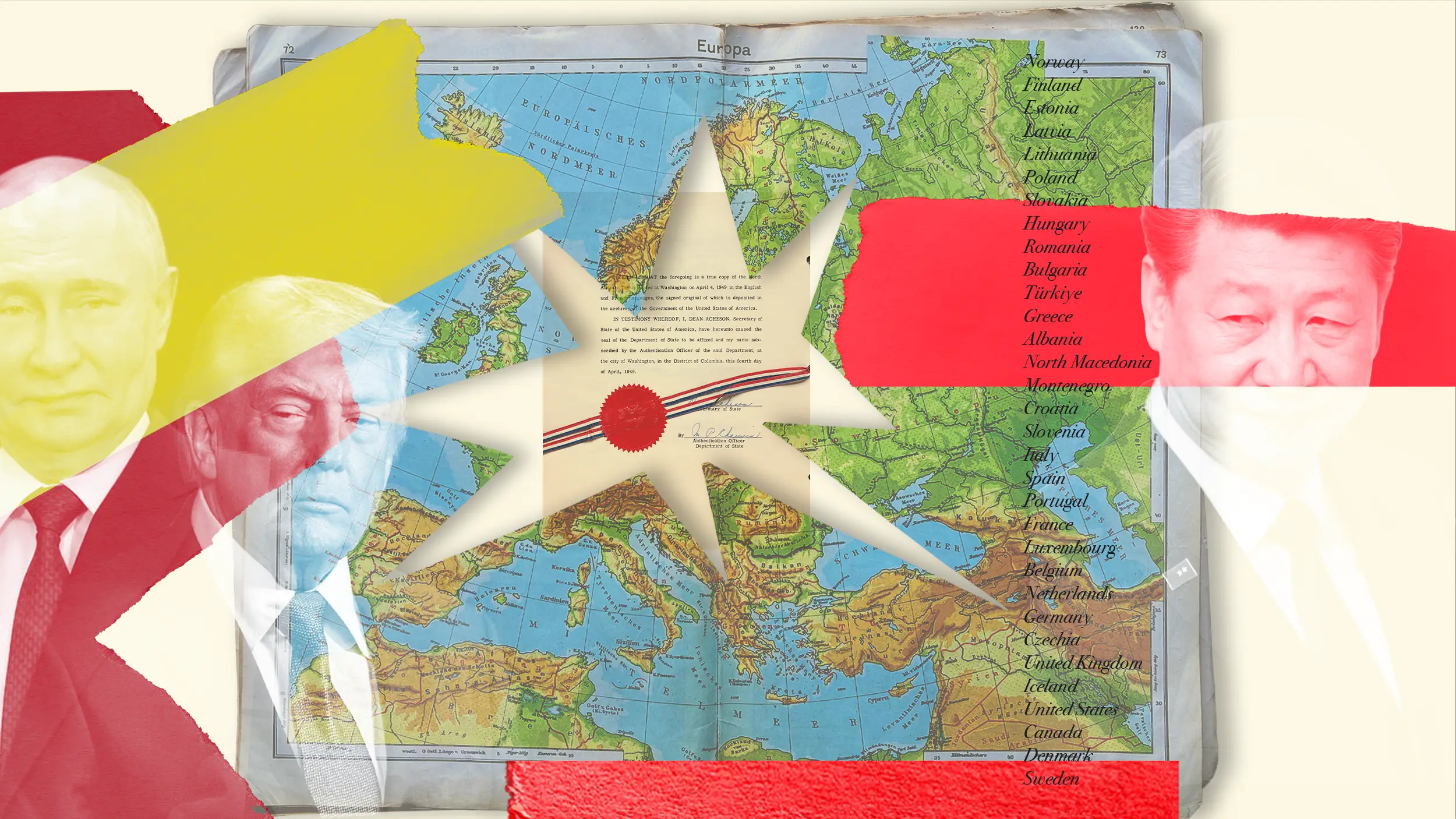
Illustration: © Sabine Mescher
Academia · Civil & NGOs · Corporate · Institutions · Intergov · Media · Non-State · States
Across dossiers: China · NATO · Russia · United States
NATO Coordination Architecture
On 8 April 2026 NATO’s secretary general, Mark Rutte, arrived at the White House. The evening before, about ninety minutes short of an American deadline, Washington and Tehran had agreed a ceasefire through mediators in Pakistan. NATO had no part in it. By 11 May Washington had announced a troop cut in Germany and, on the president’s own platform, a truce in Ukraine. DURCHD8’s study, tested against these weeks, explains how an alliance can hold together through all of it and decide none of it.
Companion Documents
Essay — A readable analytical article framing the subject, context, and significance.
Briefing — The decision-maker’s version: key findings, implications, and operational relevance.
Assessment — A concentrated analytical diagnosis for readers who need the argument.
Architectural Analysis — The complete scientific analysis.
Current State
As of 18 October 2026. The pattern of the spring has outlived the window: when a crisis moves fast, the decisive step still comes from a capital. On 11 October the American president announced an “ENERGY CEASEFIRE” between Russia and Ukraine on Truth Social, as he had announced the truce in May, and Kyiv said it was awaiting details from Washington. Al Jazeera reported that the announcement had blindsided Kyiv and its European allies. Moscow never confirmed the truce, and four days later Kyiv declared it over.
The flank now looks for answers in smaller circles. After drones struck merchant ships off Bulgaria's coast this month, the alliance's council discussed the attacks, and Bulgaria's president said NATO help was envisaged. Sofia also summoned Russia's ambassador, asked the European Council to take up Black Sea security, which it did on 16 October, and announced it would bring the matter before the UN Security Council. In Brussels on 15 October its prime minister described a proposal for a NATO headquarters for the Black Sea, possibly under a command that rotates each year among Bulgaria, Romania and Türkiye. Whether a command of three can close a crisis at the attacker's pace is the next test of the finding.
Mechanism
On 4 March 2026 allied air defence shot down an Iranian ballistic missile over Türkiye. The forces answered within minutes. The political decision stayed where it was: Türkiye requested no activation of Article 5, and the secretary general said “nobody’s talking about Article 5”. The alliance runs at two speeds. Its forces move at the pace of an attack. Its decisions need thirty-two governments, and the consultations that stand before any common defence went unused in both fast crises of the spring, over Iran in April and over the truce in Ukraine in May.
Washington was frustrated by its allies’ refusal to join the campaign against Iran. The European governments treated it as a war beyond the alliance’s area and worked through their own capitals, the E3 and ad hoc naval formats. Both kept the decision away from the common table.
The alliance once had a valve for such splits. In February 2003, with the council deadlocked over Iraq, its Defence Planning Committee authorised the defence of Türkiye. That committee was dissolved in 2010. Since then every split lands at the one table, and each departure the allies accept there becomes the baseline for the next. Whatever outruns the table goes to a capital or to a mediator from outside.
At Stake
Those who rely on a decision of the whole carry the risk. Germany builds its defence on Article 5. Under acute stress its credibility rests on a sequence of steps the alliance cannot speed up, a planning gap in the study's words. France keeps its nuclear decision in Paris, and the study notes that a guarantee running through thirty-two capitals carries a different threshold from one decided in a single capital. In Kyiv the cost was plain. On 4 May Ukraine's president said the Americans had spoken with the Russians about a truce and that “no one has contacted us officially”. An adversary calibrates against how the allies actually decide, the study finds, and the spring put that on the public record.
Once a fast crisis reaches an ally's own soil, will the council meet before the decisive step or after it?
Political Relations
Thirty-two governments sit at the council, and in the spring one of them set the pace. The United States dealt with Tehran through Pakistan and with Moscow over Ukraine, published the results on its president’s platform and announced the withdrawal of about 5,000 troops from Germany without consulting the council. Its security strategy of December 2025 calls this way of working “unconventional diplomacy”. Pakistan, a state outside the alliance, carried the ceasefire.
The Europeans answered in smaller formats. Britain, France and Germany handled parts of the Iran crisis as the E3, with Britain coordinating the coalition. Hungary changed course at the ballot box on 12 April, when Péter Magyar’s Tisza won 141 of 199 seats and he promised that Hungary would again be “a strong and reliable ally in the European Union and NATO”. Slovakia moved the other way. Its foreign ministry held up the EU’s twentieth sanctions package, and on 9 May its prime minister stood at the victory parade in Moscow.
Russia faces the alliance from outside. The study finds its coherence imposed from the top, so that it can break suddenly, where the alliance’s wears away slowly.
Research
Before its test began, the study wrote down what would prove it wrong. Four of the conditions can be checked by anyone: a European command under German and French lead free of American conditions, formal consultations under Article 4 on the Iran confrontation, a Ukraine negotiation led by the alliance, or the four Visegrád states closing ranks on a common Atlantic line. None occurred by 11 May. DURCHD8 had sealed the text on 14 April, six days after its cut-off, under a cryptographic timestamp. NATO Consensus as Ceremony carries the full argument and is open on Zenodo. NATO’s Coordination Architecture Under Stress condenses it, NATO’s Hidden Failure Mode sets six common assumptions against the record, and Brussels, Spring 2026: An Alliance Functioning Without Deciding tells it for every reader.
The study also says what would change its own reading. Only a run of such windows can tell erosion from a new division of labour. If the alliance closes a fast crisis at its own table, at the pace the attacker sets, the move of decisions to capitals reads as load-sharing. If it fails to, window after window, it reads as erosion.