
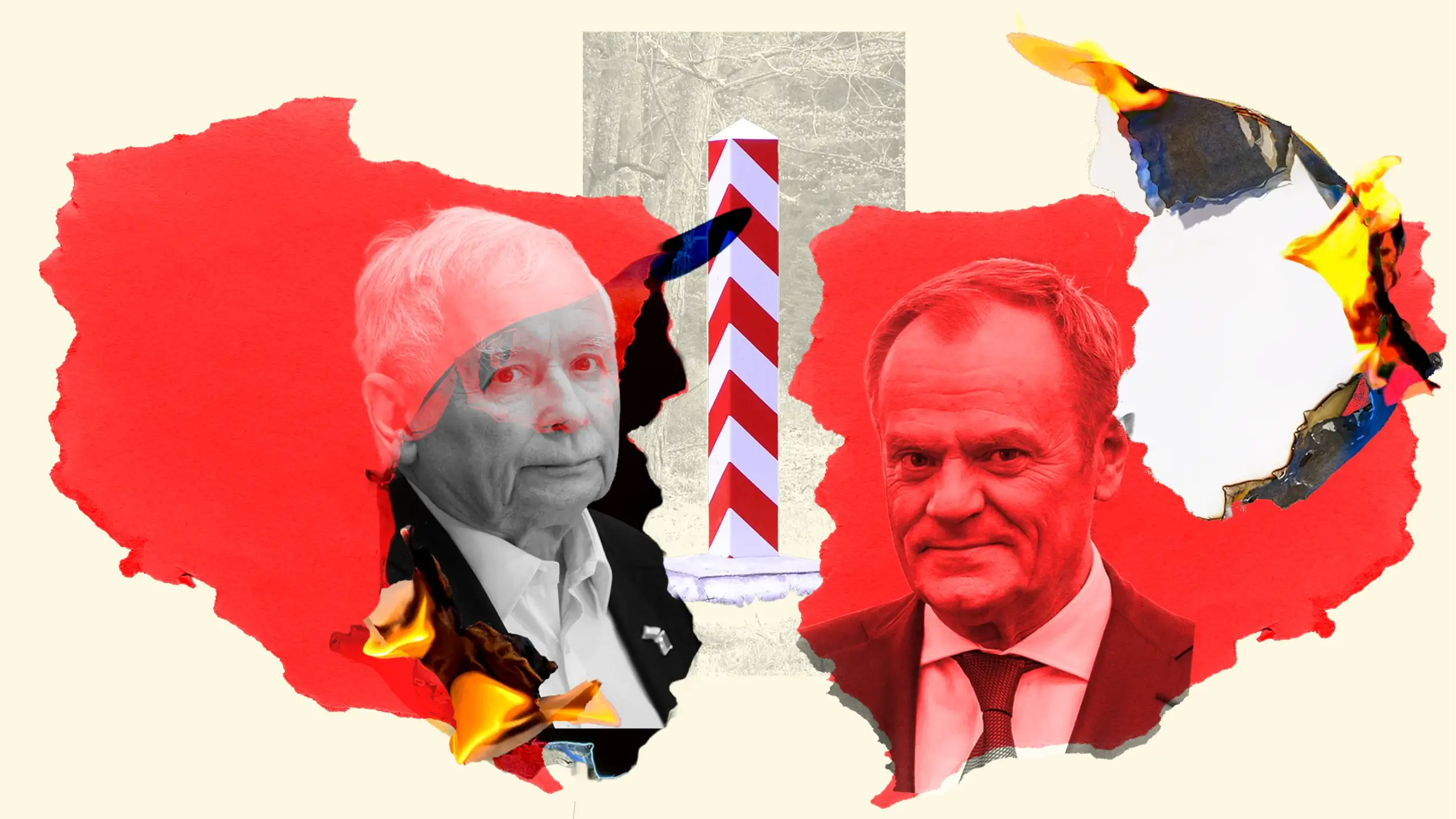
Illustration: © Sabine Mescher
Academia · Civil & NGOs · Corporate · Institutions · Intergov · Media · Non-State · States
Across dossiers: China · European Union · NATO · Poland
Poland:
EU Membership Stress
On 9 April 2026 four judges elected by the Sejm swore their oath before a notary in parliament, after the president had refused to receive it. The Constitutional Tribunal’s leadership barred them from the bench, the files and the building. A month later the government signed a 43.7 billion euro EU defence loan by cabinet resolution, eight weeks after the president’s veto. The state works around its own blockade, DURCHD8 finds. The detours keep the dispute open.
Companion Documents
Essay — A readable analytical article framing the subject, context, and significance.
Briefing — The decision-maker’s version: key findings, implications, and operational relevance.
Assessment — A concentrated analytical diagnosis for readers who need the argument.
Architectural Analysis — The complete scientific analysis.
Current State
As of 18 October 2026. On the study's own test the record is mixed, and on substance the finding holds. Four judges sworn in April are still kept from the bench, and the government ignores every ruling of the Tribunal. In July the president swore in Sławomir Patyra, chosen by the Sejm in June, and Patyra then refused to sit until his colleagues are admitted. Maciej Berek, elected in September for the seat that fell vacant on 18 September, waited for the president in vain and swore his oath in the Sejm on 14 October without him. The president says Berek lacks proof of ten years' practice as a legal counsel. Berek says he has it.
The day before, the Council of Europe's Venice Commission had found that judges may take the oath without a president who refuses it. His spokesman called its opinions advisory. Outside the Tribunal, supporters of PiS and of the president have camped to defend the building against a takeover by force, and on 14 October they clashed with police. This year the Sejm has chosen eight judges, in theory a majority of the fifteen, and the president has sworn in three. The next date on the study's calendar is the end of January 2027, when another judge's term runs out.
Mechanism
Each side holds a different kind of power. The government can act. It pays, procures and represents the state, and where a law is blocked it turns to cabinet resolutions, to prosecutors and to chargés d’affaires, who lead more than fifty of Poland’s missions abroad by the study’s count. The president and the Tribunal’s leadership can refuse. They veto, withhold oaths and keep the door shut. Each side denies the other’s acts. The detours keep the state running, and by keeping it running they remove the pressure that would force a settlement. “What holds it together is what cannot resolve it,” the public note says.
An oath before a notary in the Sejm makes a judge in the eyes of the government, the Sejm and the Strasbourg court, and a usurper in the eyes of the president, the Tribunal’s leadership and their camp. Each verdict lends legitimacy to its own camp’s institutions, and with it access to money, offices and courts. Beneath them lie two stable camps, which V-Dem has rated hostile to a large extent every year since 2011. Brussels and Strasbourg have stepped inside the dispute, one by co-signing the loan, the other by an order the Tribunal refuses.
At Stake
Legal certainty wears thin. A ruling of the Tribunal binds for one side and counts for nothing with the other, and about 3,000 judges appointed since 2018, a quarter of the judiciary, face the risk that their status is challenged. The Commission paid a first 6.6 billion euros in May under the loan the president's camp calls unlawful, and that payment sets the precedent for every later case. Part of the defence build-up on NATO's eastern flank rests on a cabinet resolution whose force can be contested. Criminal cases now reach into the other side's institutions, which raises the price of losing the election of 2027 for both camps.
If parliament and president again belong to different camps after 2027, which body could both accept as the one that decides whose acts count?
Political Relations
Donald Tusk’s coalition holds the Sejm and 63 of the 100 Senate seats, short of the 276 votes in the Sejm it would need to override a veto. Its justice minister, Waldemar Żurek, is also prosecutor general and brings the cases against officials who block the judges. The state, he said on 14 October, “must do everything to enable these judges to adjudicate”. President Karol Nawrocki holds the veto and the oath, and within ten months he vetoed more bills than any predecessor over a whole term. The head of his chancellery, Zbigniew Bogucki, called Berek’s oath “grotesque”. Bogdan Święczkowski, the Tribunal’s president and once a deputy justice minister under PiS, controls the building, the files and the bench.
Outside actors take sides through their acts. The European Court of Human Rights ordered the four judges admitted, the Venice Commission backed the Sejm’s power to elect judges, and the Commission signed the SAFE loan with the government. Washington works with the president. On the right PiS split in August, and a year before the election the government camp and the right-wing opposition each poll near half the vote.
Research
The finding rests on one flagship and three companions, all closed on 10 May 2026. Poland: Two States, One Republic, 124 pages, traces how failing channels and working detours turned, between March and May 2026, into two circuits of authority that deny each other’s acts. It sets Poland beside Hungary under Orbán, three French cohabitations, Italy in 1992 and Czechia under Babiš and Zeman. Only in Poland did a parliament swear in judges on its own. The structural assessment compresses the argument into twelve pages, and the briefing tests six common assumptions against the record, among them that the elections of 2027 and 2030 will end the dispute.
The public note named the Tribunal dates of 28 June and 18 September as its test, wrote down what would refute it, recognition at either point, and judged neither elected branch. It kept two readings open: a democracy that keeps functioning under split conditions, or an erosion that standard categories do not yet name.
Every date in these studies can be checked against the Tribunal’s own record.