

Illustration: © Sabine Mescher
Academia · Civil & NGOs · Corporate · Institutions · Intergov · Media · Non-State · States
Israel · Palestine · UNRWA · United Nations
Israel
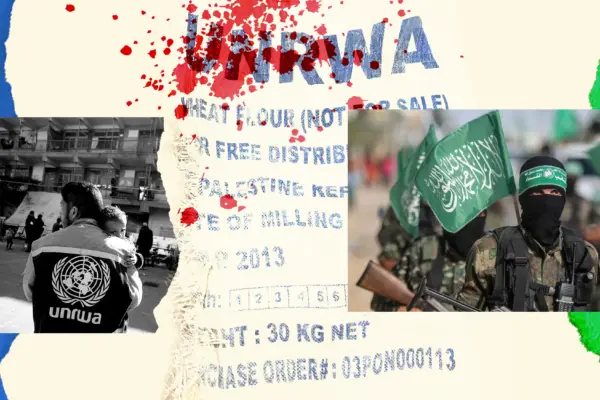
Since 24 May every load of cargo for Gaza has entered through one crossing, Kerem Shalom, where Israel decides what passes. Its army holds most of the Strip behind a line of yellow blocks. In January it recovered the body of the last hostage, and for the first time since 2014 none remained in Gaza. On 27 October Israelis elect a parliament. In DURCHD8’s Gaza studies Israel is the power around Gaza’s two systems: its force has reached Hamas, its law the UN agency, each alone, and both remain.
Current State
As of 18 October 2026. Israel goes to the polls with troops in Gaza and southern Lebanon and an unfinished war with Iran, and its next decisions on Gaza wait for the vote. On 28 February it went to war with Iran alongside the United States, and since March its army has held ground in southern Lebanon. In Gaza it holds most of the land and strikes west of the yellow line, at Hamas and other militants, it says. By the count of Gaza's health ministry, which the UN cites, the toll since the ceasefire stood at 1,431 Palestinians killed on 30 September, and at least seven Israeli soldiers have been killed in Gaza since the truce.
On 9 August Prime Minister Benjamin Netanyahu said Israel did not accept the Board of Peace's roadmap, and his government holds that the army leaves only once Hamas is disarmed. A decision on a tender for 1,234 homes in the E1 area east of Jerusalem has been put off until after the election, and the Guardian has reported, citing one source, that Israel is holding up the stabilisation force's first base. Most polls put Gadi Eisenkot's Yashar ahead of Netanyahu's Likud, and in most neither bloc reaches 61 of the 120 seats. Official results are due on 4 November.
Mechanism
Israel holds the outer ring of Gaza. It decides what crosses at Kerem Shalom, holds the land behind the yellow line and, under a law in force since January 2025, bars its officials from any contact with the UN agency. Its instruments reach Gaza’s two systems one at a time. Force went against Hamas: two years of war, and in May 2026 strikes that killed the head of its armed wing and then his reported successor. Law went against the agency: its Jerusalem headquarters was demolished and burned in January 2026, its international staff have had no Israeli visas since January 2025, and its local staff still reach 1.7 million people in Gaza. DURCHD8’s full study registers the Knesset laws, the block on the agency’s supplies from March 2025 and the return to war among the shocks the arrangement absorbed.
The plan adds a quarrel over sequence. Resolution 2803 lets the army withdraw as a stabilisation force takes control and disarmament advances, and the force has yet to arrive. For Netanyahu’s government the weapons must go first. Hamas tied its heavy weapons to a Palestinian state and, by the Associated Press’s account, sees its arsenal as the heart of its identity. Each side makes the other’s first step the condition of its own.
At Stake
The attack of 7 October 2023 killed more than 1,200 people and took 251 hostages, by the UN Secretary-General's count, and by the army's own count 474 soldiers have been killed in Gaza since the ground operation began. Soldiers now serve in Gaza and in southern Lebanon. The war with Iran has not ended. For the 2.1 million people in Gaza, Israel's hold means life on the 35 per cent of the land the UN counts as open to them. For Washington and the donor capitals, which, as DURCHD8's study reads it, own the plan together with Israel, whether its next phase starts depends on Israel's consent.
Whoever governs after 27 October will hold the gate and most of the land. Which proof of disarmament would that government accept as grounds to pull back from the yellow line, and who could deliver it?
Political Relations
Washington carries the most weight. It went to war with Iran alongside Israel, at Israel’s request by the State Department’s own legal account, and Trump himself chairs the Board of Peace whose roadmap Netanyahu rejected. Germany halted exports of arms usable in Gaza in August 2025 and lifted the halt that November. Between April and June 2026 it licensed exports worth 736 million euros, two thirds of them for one naval project, and in that quarter it shipped no weapons of war, by the government’s account. Britain, Canada and France recognised Palestine in September 2025 and announced steps against settlement goods a year later. Israel moved to close Britain’s consulate in Jerusalem, a mission nearly 200 years old. London disputes that right, and since 8 October the building has stayed open as the UK Mission. Israel deals with Hamas through Egypt, Qatar and Türkiye, the guarantors of the July deal with the United States. Iran and Hezbollah are at war with it. The International Criminal Court issued warrants for Netanyahu and his former defence minister Yoav Gallant in November 2024, and South Africa’s genocide case against Israel is in its written phase in The Hague.
Research
Israel is the power around the arrangement DURCHD8 has studied in Gaza, and the studies record its decisions where they land. The full version of North 1990: Structural Complementarity in Gaza, deposited at Zenodo in August 2026 with its record closed on 5 June, registers the Knesset laws against the UN agency, the block on the agency’s supplies from March 2025 and the food distribution that Washington and Israel backed from May 2025 among the shocks the arrangement absorbed. All five of the conditions it set for its own refutation stayed unmet. The Gaza Deadlock Under Great Power Competition counts Israeli security constraints among the forces that built the stalemate and names Israel among the owners of Resolution 2803 and its risk. It also records the talks in Moscow on 26 and 27 October 2023, where Russian diplomats received Hamas leaders and Iran’s deputy foreign minister. UNRWA Colonna Review: Neutrality Verification Collapse and The Deadlock Condition: Institutional Non-Exit for UN, UNRWA, and Donors follow the UN side, which Israel’s allegations of January 2024 set in motion.
Worth watching after 27 October is whether the next government’s first decision on Gaza reaches both systems or one.